Bible Bowl
This book is home to different bible quiz games event formats.
- Bible Bowl: The Book of Judges
- General Information
- Section 2 Notes
- Section 1 Notes
- Section 3 Notes
- Outline of Judges
- Section 4
- Judges Questions
- Judges Introduction
- Bible Bowl: Gospel of Matthew
- Bible Bowl: James
- Bible Elimination Trivia
Bible Bowl: The Book of Judges
Bible Bowl Date February 26, 2023
General Information
Date
Bible Bowl date: June 11, 2023
Scripture Passage
-
The Book of Judges
-
21 Chapters and 618 verses
-
To Read in 6 weeks: Read 103 verses a week which is ~15 verses a day
-
Week 1: Judges 1:1 to Judges 4:15
-
Week 2: Judges 4:16 to Judges 7:25
-
Week 3: Judges 8:1 to Judges 10:13
-
Week 4: Judges 10:14 to Judges 14:20
-
Week 5: Judges 15:1 to Judges 19:10
-
Week 6: Judges 19:11 to Judges 21:25
-
[reading plan](https://biblereadingplangenerator.com/?start=2023-02-19&total=21&format=calendar&order=traditional&daysofweek=1,2,3,4,5,6,7&books=JDG&lang=en&logic=words&checkbox=1&colors=0&dailypsalm=0&dailyproverb=0&otntoverlap=0&reverse=0&stats=0&dailystats=0&nodates=0]
Tips
-
Keep a Journal to track your reading progress but also to make note of important ideas you read about. Writing something down will improve your ability to remember.
-
Pick a schedule and be consistent. Read at least once a day and try to read at the same time(s) every day.
-
If you fall behind, just do a little math and spread the number of verses behind over the course of a week instead of trying to catch all up in one day.
-
Make time for both reading and reviewing what you have read. Perhaps, separate these aspects as follows: read the day's passages in the morning and in the evening review the passage making some kind of note and comment on the passage.
-
Some popular verses to memorize: 1:1-3,5,9,19; 4:5,10; 6:12; 11:30-31; 12:6; 13:1,5,15-16,18; 14:6,18
-
Take time each day to talk to someone about what you read.
Bible Bowl Outline
Rules
- Participants:
- There will be 6 contestants: Benjamin, Elizabeth, Elyanna, Jeremiah, Rosemary, Stephen. The Bible Bowl is expected to take 1.25 to 1.5 hrs to complete.
- There will be (1) moderator: Stephen Jr.
- There will be (2) judges for all scoring decisions announced before the Bible Bowl begins.
- There will be (1) timekeeper to track all time related events.
- There will be 3 events:
- Bible Memory
- Monologue
- Quiz
- Prizes:
- 6 Prizes will awarded (1-6) for 1st through 6th places in 1) Bible Memory. Places will be graded by most correctly quoted verses (with 1 or less mistakes) from the book of Judges.
- A single prize will be awarded for best 2) Monologue. Monologues will be ranked by the 2 judges.
- 1st and 2nd prizes will be awarded for the top 2 scores in the 3) Quiz event.
Format
Service will begin with prayer and worship. Followed by 1) Bible Memory Event. 2) Monologues will immediately follow. A brief intermission will then be taken for the third and final event 3) Quiz.
1. Bible Memory (~30 minutes)
Each contestant will be given 5 minutes to quote from memory as many verses as possible. To receive credit from a verse, no more than one error can be made.
A minimum of 3 correctly quoted verses is necessary to place.
2. Monologues (~20 minutes)
Each contestant will be given 3 minutes to give a monlogue on your chose judge/judges. Props and constumes are permitted, but no setup will be allowed that can not be completed in less than 1 minute.
A timekeeper will signal when time is up. Contestant must use at least 2 minutes and no more than 3 minutes to complete.
3. Quiz (~30 minutes)
- There will be 30 questions/tasks to be completed by each contestant.
- These questions will be a combination of individual and team tasks. Some tasks may require educated guesses and the judges will assess the correctness of these.
Section 2 Notes
- Jg 4:17-24. Jael kills Sisera.
- Jg 5:1-31. The Song of Deborah and Barak.
- Jg 6:1-7. The Israelites for their sin are oppressed by Midian.
- Jg 6:8-10. A prophet rebukes them.
- Jg 6:11-16. An angel sends Gideon for their deliverance.
- Jg 6:17-23. Gideon's present is consumed with fire.
- Jg 6:24-27. Gideon destroys Baal's altar, and offers a sacrifice upon the altar Jehovah-shalom.
- Jg 6:28-32. Joash defends his son, and calls shim Jerubbaal.
- Jg 6:33-35. Gideon's army.
- Jg 6:36-40. Gideon's signs.
- Jg 7:1-8. Gideon's army of two and thirty thousand is brought to three hundred.
- Jg 7:9-15. He is encouraged by the dream and interpretation of the burley cake.
- Jg 7:16-23. His stratagem of trumpets and lamps in pitchers.
- Jg 7:24-25. The Ephraimites take Oreb and Zeeb.
Section 1 Notes
- Jg 1:1-3. The acts of Judah and Simeon.
- Jg 1:4-7. Adonibezek justly requited.
- Jg 1:8-9. Jerusalem taken.
- Jg 1:10. Hebron taken.
- Jg 1:11-15. Othniel has Achsah to wife for taking of Debir.
- Jg 1:16. The Kenites dwell in Judah.
- Jg 1:17-20. Hormah, Gaza, Askelon, and Ekron taken.
- Jg 1:21. The acts of Benjamin.
- Jg 1:22-29. Of the house of Joseph, who take Beth-el.
- Jg 1:30. Of Zebulun.
- Jg 1:31-32. Of Asher.
- Jg 1:33. Of Naphtali.
- Jg 1:34-36. Of Dan.
- Jg 2:1-5. An angel rebukes the people at Bochim.
- Jg 2:6-13. The wickedness of the new generation after Joshua.
- Jg 2:14-19. God's anger and pity towards them.
- Jg 2:20-23. The Canaanites left to prove Israel.
- Jg 3:1-4. The nations which were left to prove Israel.
- Jg 3:5-7. By communion with them they commit idolatry.
- Jg 3:8-11. Othniel delivered them from Chushan-rishathaim;
- Jg 3:12-30. Ehud from Eglon;
- Jg 3:31. and Shamgar from the Philistines.
- Jg 4:1-16. Deborah and Barak deliver them from Jabin and Sisera.
Section 3 Notes
- Judges chapter 8
- Jg 8:1-3. Gideon pacifies the Ephraimites.
- Jg 8:4-9. Succoth and Penuel refuse to deliver Gideon's army.
- Jg 8:10-12. Zebah and Zalmunna are taken.
- Jg 8:13-16. Succoth and Penuel are destroyed.
- Jg 8:17-21. Gideon revenges his brethren's death on Zebah and Zalmunna.
- Jg 8:22-23. He refuses government.
- Jg 8:24-27. His ephod the cause of idolatry.
- Jg 8:28. Midian subdued.
- Jg 8:29-32. Gideon's children, and death.
- Jg 8:33-35. The Israelites' idolatry and ingratitude.
- Judges chapter 9
- Jg 9:1-6. Abimelech by conspiracy with the Shechemites, and murder of his brethren, is made king.
- Jg 9:7-21. Jotham by a parable rebukes them, and foretells their ruin.
- Jg 9:22-29. Gaal conspires with the Shechemites against him.
- Jg 9:30-33. Zebul reveals it.
- Jg 9:34-45. Abimelech overcomes them, and sows the city with salt.
- Jg 9:46-49. He burns the hold of the god Berith.
- Jg 9:50-55. At Thebez he is slain by a piece of a millstone.
- Jg 9:56-57. Jotham's curse if fulfilled.
Outline of Judges
- Judges chapter 1
- Jg 1:1-3. The acts of Judah and Simeon.
- Jg 1:4-7. Adonibezek justly requited.
- Jg 1:8-9. Jerusalem taken.
- Jg 1:10. Hebron taken.
- Jg 1:11-15. Othniel has Achsah to wife for taking of Debir.
- Jg 1:16. The Kenites dwell in Judah.
- Jg 1:17-20. Hormah, Gaza, Askelon, and Ekron taken.
- Jg 1:21. The acts of Benjamin.
- Jg 1:22-29. Of the house of Joseph, who take Beth-el.
- Jg 1:30. Of Zebulun.
- Jg 1:31-32. Of Asher.
- Jg 1:33. Of Naphtali.
- Jg 1:34-36. Of Dan.
- Judges chapter 2
- Jg 2:1-5. An angel rebukes the people at Bochim.
- Jg 2:6-13. The wickedness of the new generation after Joshua.
- Jg 2:14-19. God's anger and pity towards them.
- Jg 2:20-23. The Canaanites left to prove Israel.
- Judges chapter 3
- Jg 3:1-4. The nations which were left to prove Israel.
- Jg 3:5-7. By communion with them they commit idolatry.
- Jg 3:8-11. Othniel delivered them from Chushan-rishathaim;
- Jg 3:12-30. Ehud from Eglon;
- Jg 3:31. and Shamgar from the Philistines.
- Judges chapter 4
- Jg 4:1-16. Deborah and Barak deliver them from Jabin and Sisera.
- Jg 4:17-24. Jael kills Sisera.
- Judges chapter 5
- Jg 5:1-31. The Song of Deborah and Barak.
- Judges chapter 6
- Jg 6:1-7. The Israelites for their sin are oppressed by Midian.
- Jg 6:8-10. A prophet rebukes them.
- Jg 6:11-16. An angel sends Gideon for their deliverance.
- Jg 6:17-23. Gideon's present is consumed with fire.
- Jg 6:24-27. Gideon destroys Baal's altar, and offers a sacrifice upon the altar Jehovah-shalom.
- Jg 6:28-32. Joash defends his son, and calls shim Jerubbaal.
- Jg 6:33-35. Gideon's army.
- Jg 6:36-40. Gideon's signs.
- Judges chapter 7
- Jg 7:1-8. Gideon's army of two and thirty thousand is brought to three hundred.
- Jg 7:9-15. He is encouraged by the dream and interpretation of the burley cake.
- Jg 7:16-23. His stratagem of trumpets and lamps in pitchers.
- Jg 7:24-25. The Ephraimites take Oreb and Zeeb.
- Judges chapter 8
- Jg 8:1-3. Gideon pacifies the Ephraimites.
- Jg 8:4-9. Succoth and Penuel refuse to deliver Gideon's army.
- Jg 8:10-12. Zebah and Zalmunna are taken.
- Jg 8:13-16. Succoth and Penuel are destroyed.
- Jg 8:17-21. Gideon revenges his brethren's death on Zebah and Zalmunna.
- Jg 8:22-23. He refuses government.
- Jg 8:24-27. His ephod the cause of idolatry.
- Jg 8:28. Midian subdued.
- Jg 8:29-32. Gideon's children, and death.
- Jg 8:33-35. The Israelites' idolatry and ingratitude.
- Judges chapter 9
- Jg 9:1-6. Abimelech by conspiracy with the Shechemites, and murder of his brethren, is made king.
- Jg 9:7-21. Jotham by a parable rebukes them, and foretells their ruin.
- Jg 9:22-29. Gaal conspires with the Shechemites against him.
- Jg 9:30-33. Zebul reveals it.
- Jg 9:34-45. Abimelech overcomes them, and sows the city with salt.
- Jg 9:46-49. He burns the hold of the god Berith.
- Jg 9:50-55. At Thebez he is slain by a piece of a millstone.
- Jg 9:56-57. Jotham's curse if fulfilled.
- Judges chapter 10
- Jg 10:1-2. Tola judges Israel in Shamir.
- Jg 10:3-5. Jair, whose thirty sons had thirty cities.
- Jg 10:6-9. The Philistines and Ammonites oppress Israel.
- Jg 10:10-14. In their misery God sends them to their false gods.
- Jg 10:15-18. Upon their repentance he pities them.
- Judges chapter 11
- Jg 11:1-11. The covenant between Jephthah and the Gileadites, that he should be their head.
- Jg 11:12-28. The treaty of peace between him and the Ammonites is in vain.
- Jg 11:29-31. Jephthah's vow.
- Jg 11:32-33. His conquest of the Ammonites.
- Jg 11:34-40. He performs his vow on his daughter.
- Judges chapter 12
- Jg 12:1-6. The Ephraimites, quarrelling with Jephthah, and discerned by Shibboleth, are slain by the Gileadites.
- Jg 12:7. Jephthah dies.
- Jg 12:8-10. Ibzan, who had thirty sons, and thirty daughters;
- Jg 12:11-12. and Elon;
- Jg 12:13-15. and Abdon, who had forty sons, and thirty nephews, judge Israel.
- Judges chapter 13
- Jg 13:1. Israel is delivered into the hands of Philistines.
- Jg 13:2-7. An angel appears to Manoah's wife.
- Jg 13:8-14. The angel appears to Manoah.
- Jg 13:15-23. Manoah's sacrifices, whereby the angel is discovered.
- Jg 13:24-25. Samson is born.
- Judges chapter 14
- Jg 14:1-5. Samson desires a wife of the Philistines.
- Jg 14:6-7. In his journey he kills a lion.
- Jg 14:8-9. In a second journey he finds honey in the carcase.
- Jg 14:10-11. Samson's marriage feast.
- Jg 14:12-18. His riddle by his wife is made known.
- Jg 14:19. He spoils thirty Philistines.
- Jg 14:20. His wife is married to another.
- Judges chapter 15
- Jg 15:1-2. Samson is denied his wife.
- Jg 15:3-5. He burns the Philistines' corn with foxes and firebrands.
- Jg 15:6. His wife and her father are burnt by the Philistines.
- Jg 15:7-8. Samson smites them hip and thigh.
- Jg 15:9-13. He is bound by the men of Judah, and delivered to the Philistines.
- Jg 15:14-17. He kills them with a jawbone.
- Jg 15:18-20. God makes the fountain En-hakkore for him in Lehi.
- Judges chapter 16
- Jg 16:1-3. Samson at Gaza escapes, and carries away the gates of the city.
- Jg 16:4-5. Delilah, corrupted by the Philistines, entices Samson.
- Jg 16:6-14. Thrice she is deceived.
- Jg 16:15-20. At last she overcomes him.
- Jg 16:21. The Philistines take him, and put out his eyes.
- Jg 16:22-31. His strength renewing he pulls down the house upon the Philistines, and dies.
- Judges chapter 17
- Jg 17:1-4. Of the money that Micah first stole, then restored, his mother makes images;
- Jg 17:5-6. and he ornaments for them.
- Jg 17:7-13. He hires a Levite to be his priest.
- Judges chapter 18
- Jg 18:1-2. The Danites send five men to seek out an inheritance.
- Jg 18:3-6. At the house of Micah they consult with Jonathan, and are encouraged on their way.
- Jg 18:7-10. They search Laish, and bring back news of good hope.
- Jg 18:11-13. Six hundred men are sent to surprise it.
- Jg 18:14-26. In their way they rob Micah of his priest and his consecrated things.
- Jg 18:27-29. They win Laish, and call it Dan.
- Jg 18:30-31. They set up idolatry, wherein Jonathan inherits the priesthood.
- Judges chapter 19
- Jg 19:1-15. A Levite goes to Beth-lehem to fetch home his concubine.
- Jg 19:16-21. An old man entertains him at Gibeah.
- Jg 19:22-28. The Gibeonites abuse his concubine to death.
- Jg 19:29-30. He divides her into twelve pieces, and sends them to the twelve tribes.
- Judges chapter 20
- Jg 20:1-7. The Levite in a general assembly declares his wrong.
- Jg 20:8-11. The decree of the assembly.
- Jg 20:12-17. The Benjamites, being cited, make head against the Israelites.
- Jg 20:18-25. The Israelites in two battles lose forty thousand.
- Jg 20:26-48. They destroy by a stratagem all the Benjamites, except six hundred.
- Judges chapter 21
- Jg 21:1-7. The people bewail the desolation of Benjamin.
- Jg 21:8-15. By the destruction of Jabesh-gilead they provide them four hundred wives.
- Jg 21:16-25. They advise the remainder to surprise the virgins that danced at Shiloh.
Section 4
Judges chapter 10
- Jg 10:1-2. Tola judges Israel in Shamir.
- Jg 10:3-5. Jair, whose thirty sons had thirty cities.
- Jg 10:6-9. The Philistines and Ammonites oppress Israel.
- Jg 10:10-14. In their misery God sends them to their false gods.
- Jg 10:15-18. Upon their repentance he pities them.
Judges chapter 11
- Jg 11:1-11. The covenant between Jephthah and the Gileadites, that he should be their head.
- Jg 11:12-28. The treaty of peace between him and the Ammonites is in vain.
- Jg 11:29-31. Jephthah's vow.
- Jg 11:32-33. His conquest of the Ammonites.
- Jg 11:34-40. He performs his vow on his daughter.
Judges chapter 12
- Jg 12:1-6. The Ephraimites, quarrelling with Jephthah, and discerned by Shibboleth, are slain by the Gileadites.
- Jg 12:7. Jephthah dies.
- Jg 12:8-10. Ibzan, who had thirty sons, and thirty daughters;
- Jg 12:11-12. and Elon;
- Jg 12:13-15. and Abdon, who had forty sons, and thirty nephews, judge Israel.
Judges chapter 13
- Jg 13:1. Israel is delivered into the hands of Philistines.
- Jg 13:2-7. An angel appears to Manoah's wife.
- Jg 13:8-14. The angel appears to Manoah.
- Jg 13:15-23. Manoah's sacrifices, whereby the angel is discovered.
- Jg 13:24-25. Samson is born.
Judges chapter 14
- Jg 14:1-5. Samson desires a wife of the Philistines.
- Jg 14:6-7. In his journey he kills a lion.
- Jg 14:8-9. In a second journey he finds honey in the carcase.
- Jg 14:10-11. Samson's marriage feast.
- Jg 14:12-18. His riddle by his wife is made known.
- Jg 14:19. He spoils thirty Philistines.
- Jg 14:20. His wife is married to another.
Judges chapter 15
- Jg 15:1-2. Samson is denied his wife.
- Jg 15:3-5. He burns the Philistines' corn with foxes and firebrands.
- Jg 15:6. His wife and her father are burnt by the Philistines.
- Jg 15:7-8. Samson smites them hip and thigh.
- Jg 15:9-13. He is bound by the men of Judah, and delivered to the Philistines.
- Jg 15:14-17. He kills them with a jawbone.
- Jg 15:18-20. God makes the fountain En-hakkore for him in Lehi.
Judges chapter 16
- Jg 16:1-3. Samson at Gaza escapes, and carries away the gates of the city.
- Jg 16:4-5. Delilah, corrupted by the Philistines, entices Samson.
- Jg 16:6-14. Thrice she is deceived.
- Jg 16:15-20. At last she overcomes him.
- Jg 16:21. The Philistines take him, and put out his eyes.
- Jg 16:22-31. His strength renewing he pulls down the house upon the Philistines, and dies.
Judges chapter 17
- Jg 17:1-4. Of the money that Micah first stole, then restored, his mother makes images;
- Jg 17:5-6. and he ornaments for them.
- Jg 17:7-13. He hires a Levite to be his priest.
Judges chapter 18
- Jg 18:1-2. The Danites send five men to seek out an inheritance.
- Jg 18:3-6. At the house of Micah they consult with Jonathan, and are encouraged on their way.
- Jg 18:7-10. They search Laish, and bring back news of good hope.
- Jg 18:11-13. Six hundred men are sent to surprise it.
- Jg 18:14-26. In their way they rob Micah of his priest and his consecrated things.
- Jg 18:27-29. They win Laish, and call it Dan.
- Jg 18:30-31. They set up idolatry, wherein Jonathan inherits the priesthood.
Judges chapter 19
- Jg 19:1-15. A Levite goes to Beth-lehem to fetch home his concubine.
- Jg 19:16-21. An old man entertains him at Gibeah.
- Jg 19:22-28. The Gibeonites abuse his concubine to death.
- Jg 19:29-30. He divides her into twelve pieces, and sends them to the twelve tribes.
Judges chapter 20
- Jg 20:1-7. The Levite in a general assembly declares his wrong.
- Jg 20:8-11. The decree of the assembly.
- Jg 20:12-17. The Benjamites, being cited, make head against the Israelites.
- Jg 20:18-25. The Israelites in two battles lose forty thousand.
- Jg 20:26-48. They destroy by a stratagem all the Benjamites, except six hundred.
Judges chapter 21
- Jg 21:1-7. The people bewail the desolation of Benjamin.
- Jg 21:8-15. By the destruction of Jabesh-gilead they provide them four hundred wives.
- Jg 21:16-25. They advise the remainder to surprise the virgins that danced at Shiloh.
Judges Questions
https://www.funtrivia.com/en/Religion/Judges-16850_3.html
- Gideon assembled 32,000 troops to confront Israel's foes, but God told him he didn't need that many. How many men did actually fight the Midianites?
a) 30,000 b) 3,000 c) 300 d) 30
- 300
- "God, according to His word, gave the Israelites victory against the Canaanites' army when Deborah was the Judge. Sisera, the Canaanite commander, fled and took refuge in the tent of Heber, a Canaanite ally. Heber's wife, on the other hand, killed Sisera in the tent. What was her name, exactly?"
- Jedidah, Jezebel, Jochebed, jael
- jael
- "After Ehud's reign, the Israelites rebelled against God once more. God punished them by allowing the Canaanite King Jabin to afflict them for a period of 20 years. What distinguished the 4th Judge, who assisted in the defeat of the Canaanites? "
a) 4th Judge who was the only non-Israelite Judge b) 4th Judge who the only judge from the tribe of Levi c) 4th Judge who was the only child judge d) 4th Judge who was the only female judge
- d) "Deborah was the fourth judge, who was a prophetess, judge, and warrior. She urged Israel’s men to battle the Canaanites, promising that God would provide them victory. She fought to defeat Jabin the king of Canaan."
- "The Israelites were once again harassed by adversaries, this time the Ammonites. Jephthah, the Judge who fought the Ammonites, pledged to God before the battle that if he triumphed, he would sacrifice the first thing he saw when he came back home. When he arrived after winning the war, what's the first thing he saw? " Judges 11:39-40
a) His Daughter b) his wife c) His son d) His mother
- a)
- What was the symbol of Samson's strength? a) never cutting his finger nails b) never cutting his hair c) never eating fish d) never eating meat
- b) never cutting his hair
- "This judge had thirty sons, each of whom rode thirty donkeys, and they owned thirty cities in Gilead? " a) Jair b) Elon c) Abdon d) Ibzan
- a)
Jair was a person of great riches and power.
- "In the Book of Judges, how many judges are mentioned?"
a) 16 b) 15 c) 14 d) 13 e) 12 f) 11 g) 10
- e)12
- "The name of this judge from the tribe of Zebulun means "oak tree" or "strong". "
a) Jephtha b) Shamgar c) Elon d) Othniel
- Judges 12:11-12 c)Elon
- "With an oxgoad, this judge killed 600 Philistines and saved Israel."
- Judges 3:31, Shamgar
- "This judge had 40 sons and 30 grandsons who rode on 70 ass colts or donkeys. He was the 11th judge of Israel."
a) Tola b) Ibzan c) Jair d) Abdon
- d) Judges 12:14 "Abdon was very affluent and influential. He restored order in Israel after the catastrophic civil war between the Gileadites and Ephraimites. " "Abdon was very affluent and influential. He restored order in Israel after the catastrophic civil war between the Gileadites and Ephraimites. " He led Israel eight years.
- How many troops where originally assembled to Gideon before God directed him in reducing its size?
a) 64,000 b) 32,000 c) 16,000 d) 8,000
- b) 32,000 Judges 7:3)
- "In the Book of Judges, how many judges are mentioned?"
a) 7 b) 12 c) 10 d) 21
- b) 12 "Othniel, Ehud, Shamgar, Deborah, Gideon, Tolah, Jair, Jephthah, Ibzan, Elon, Abdon, and Samson were the names of the judges. Although some consider Abimelech to be the 13th judge, he is not traditionally listed among the judges and is considered a usurper."
- "The name of this judge means "Crimson Worm" or "Scarlet Stuff". He succeeded Abimelech, who was the son of Gideon's concubine, whose three-year reign of terror threw Israel into chaos."
a) Tola b) Elon c) Abdon d) Sisera
- a) Judges 10:1,2 "After the time of Abimelek, a man of Issachar named Tola son of Puah, the son of Dodo, rose to save Israel. He lived in Shamir, in the hill country of Ephraim." He led Israel twenty-three years; then he died, and was buried in Shamir.
- Why wouldn't Abimelech be listed as a 13th judge?
- Abimelech considered a usurper? He was the son of Gideon. He sought to rule over Shechem by killing all the other sons of Gideon who were all salain except for gideon's youngest son, Jotham. Abimlech rulled for 3 years before a conspiracy rose against him and overthrew him. A civil war broke out, leading to a battle at a town called Thebez where Abimelech surrounded the leaders of the city in a tower and approached with the intention of burning it down. However, a woman in the tower heroically dropped a large rock on Abimelech's head and cracked his skull. Nearing death, he called out to a comrade to stab him as being killed by a woman was considered disgraceful in that time. This was an appropriate end for Abimelech's malevolent regime and the evil he had committed against his own brothers and people. In contrast to the positive lead of his father, Abimelech focused on his own personal gain, hurting many in the process.
- From What tribe did Ehud come?
- Benjamin (son of my right hand), and Ehud was left-handed
- According to Judges 1:13, who is the uncle/brother of Othniel?
- Caleb
- Before Joshua died, Israel overthrew the king of Bezek. What was his name?
- Adoni-Bezek Judges 1:4-5
- Ehud, described as "a Benjamite, a left-handed man." Ehud freed the Israelites from the Moabite king Eglon by bringing tribute into the palace, then assassinating the king in his private chamber. How did Ehud then escape from the palace and all the guards?
- Judges 3 He locked the chamber door, and the servants assumed Eglon was relieving himself and so didn't know he had been killed until well after Ehud had left.
- What did the whole Benjamite war start over?
- Judges 19 The deceased woman of the Levite.
- Who was Deborah married to?
- Judges 4:4 Lapidoth
- After Joshua died this tribe was the first to go against the Canaanites.
- Judah Judges 1:1
- According to Judges chapter 2, how did the Israelites respond after the Angel (Messenger) of the LORD spoke to them and what did they name this where the Lord appeared to them?
- Answer: They wept or cried.
The Angel or Messenger of the LORD (Theophany) spoke to the Israelites and told them how He brought them out of Egyptian slavery. He reminded them how He asked them to not make a treaty with the Canaanites, but they didn't obey Him. God told the Israelites that because they disobeyed Him, He wouldn't force the people out and their gods would become a trap for the Israelites. When they heard the words of the holy God, they wept because they were ashamed and remorseful.
The Israelites named the area where the Angel of the LORD appeared to them "Bochim", which means "those who cry", according to the Names of God (NOG) translation.
- How was Adoni-Bezek punished by Israel?
- Answer: Judges 1:6 They cut off his thumbs and big toes
- "Eg´lon the king of Mo´ab grow strong against Israel ... he gathered against them the sons of Am´mon and Am´a·lek. Then they went and struck Israel and took possession of the city of palm trees." -Judges 3:12,13 How long after this were the Israelites servants of Mo'ab?
- Judges 3:14 18
- 19 Who was the captain of King Jabin's army?
- Answer: Judges 4:7, Sisera
- Othniel received the daughter of Caleb to wife after he defeated who?
- Kirjathsepher, Judges 1:12-13
What does the word translated "judges" most nearly mean? Answer: Saviors
The judges were, at a minimum, people who delivered (or saved) Israel from its oppressors. Many of them also served as rulers of the people. From Quiz: Judges
22 What judge was left-handed? Answer: Ehud
Ehud was left-handed, a trait that was considered a handicap at this time. God used his left-handedness to bring victory to the Israelites. He ruled in conjunction with Shamgar. His period is detailed in Judges 3:12-31. From Quiz: When the Judges Ruled Israel 23 According to Judges chapter 11, Jephthah's half-brothers told him that he wouldn't receive any inheritance from their father, because his mother was considered a woman of ill repute. According to the Living Bible and several other translations, what type of woman was Jephthah's mother? Answer: A prostitute
Judges 11:1-3, the Living Bible (TLB): "Now Jephthah was a great warrior from the land of Gilead, but his mother was a prostitute. His father (whose name was Gilead) had several other sons by his legitimate wife, and when these half brothers grew up, they chased Jephthah out of the country. 'You son of a whore!' they said. 'You'll not get any of our father's estate.' So Jephthah fled from his father's home and lived in the land of Tob. Soon he had quite a band of malcontents as his followers, living off the land as bandits."
The chapter goes on to state that after a while, the elders of Gilead (his brothers, I presume) asked Jephthah to be their army commander. They were in a war with the Ammonites. Jepthtah questioned their motives at first, but then they made an agreement before God. He successfully led their army.
Some translations, such as the New King James Version (NKJV), use "harlot." In addition to the TLB, other translations that use the exact word "prostitute" include the Amplified Bible (AMP), the Christian Standard Bible (CSB), the English Standard Version (ESV), and the Names of God Bible (NOG), to name a few. Although "harlot" and "prostitute" are synonyms, there is apparently a distinction because a "harlot" is any promiscuous woman--she may or may NOT get paid for it--while a "prostitute" is a woman who has sex for money.
Question submitted by Ceduh From Quiz: Here Come the Judges, Here Come the Judges 24 How old was Joshua when he died? Answer: 110
Judges 2:8. After Joshua's death, the children of Israel began to sin. Thus beginning the era of the Judges. From Quiz: BT: the Period of the Judges 25 This judge is only mentioned twice in the whole Bible. He is known for killing 600 Philistines with an ox-goad. Answer: Shamgar
Judges 3:31, "After Ehud came Shamgar son of Anath, who struck down six hundred Philistines with an oxgoad. He too saved Israel."
An oxgoad is a farmers tool for getting ox to move. It was usually about 8 feet long and had a pointy end. In desperate times, they were sometimes used as spears. Your options: [ Shamgar ] [ Tola ] [ Jephthah ] [ Ibzan ] From Quiz: Judges, Revival Story of the Bible 26 The next judge described was Gideon. The Midianites and the Amalekites were "laying waste" the land, with an army like locusts destroying crops throughout Israel. The Lord told Gideon to defeat the enemy, but Gideon didn't think he was capable and asked God to give him signs that God really would assure success. Which sign finally convinced Gideon to form an army? Answer: A fleece was dry while the ground around it was wet.
The sundial pair of signs is from the story of Hezekiah in 2 Kings 20. Hezekiah chose between the two possible signs, while in Judges 6 Gideon insisted on both fleece signs, one each on two consecutive nights. Your options: [ The shadow on the sundial moved backward 5 degrees. ] [ A fleece was wet while the ground around it was dry. ] [ A fleece was dry while the ground around it was wet. ] [ The shadow on the sundial moved forward 5 degrees. ] From Quiz: BBB Bible Series: The Old Testament Book of Judges 27 The newly formed Israelite army went against Benjamin and demanded what specific thing of the Benjamites? Answer: That they give up the guilty men
According to Judges 20:12-13, the Israelites demanded that the Benjamites give over the guilty men so that they could be executed. The Benjamites refused (Judges 20:13) and formed their own army to fight against Israel (Judges 20:14). From Quiz: The Benjamite War
28 Which judge killed 600 Philistines with an ox goad? Answer: Shamgar
This story only takes up one verse in the Bible, Judges 3:31. The index of proper names in the back of my Bible says that "Shamgar" possibly means "destroyer". Do you think his parents knew what they were naming him? Your options: [ Shamgar ] [ Jair ] [ Tola ] [ Ibzan ] From Quiz: Old Testament Judges 29 What did E'hud the left-handed Ben´ja·mite say to Eg´lon the very fat king of Mo´ab that got him to dismiss his servants, and gave E'hud the chance to kill the king? Answer: "I have a secret word for you, O king."
"...and he proceeded to say: "I have a secret word for you, O king." So he said: "Keep silence!" With that all those who were standing by him went on out from him." -Judges 3:19 In Hebrew Eg'lon means little calf. From Quiz: Do You Know 'Judges'? 30 What was the name of Joash's son? Answer: Gideon
Judges Introduction
TEXT: Judges 6-8
Highlight Texts:
Some Numbers
- The Book of Judges covers a period of about 410 years by the Chronology included if you place everything consecively. (The period of the Judges extends from the death of Joshua to the establishment of the monarchy.) But the actual span of time is uncertain and perhaps requiring more complex calculations. (180 years from Joshua's Death to Saul's reign - 1200 b.c.—1020 b.c by dating from other nations' histories). It is likely, therefore, that the periods of foreign oppression and of the individual judges, overlapped. This allows serious consideration of the chronological data within the Book of Judges, but care is required in interpreting the figures.
- The Number "40". The recurrence of the figure forty and its multiples suggests that it may be a round figure to indicate a generation. (Judges 3:11; 5:31; 8:28; 13:1)
- Number of sons/daughters/nephews: Anak's 3 sons (1:20); Gideon had 70 sons (8:30); Jair had 30 sons (10:3,4); Ibzan had 30 sons and 30 daughters (12:8,9); Abdon had 40 sons and 30 nephews (12:13,14);
- 12 Judges Listed in the book of Judges (but a list of judges would not be complete without Samuel; The high priest would also be regarded as a judge (cf. 1 Sam 4:18) as the central sanctuary was, traditionally, the place of arbitration.)
- The 12 Judges were the resistance to at least 9 oppressors. (Cushan-Rishathaim, King of Mesopotamia, Eglon king of Moab, Ammonites and Amalekites-"People of the East", Philistines, Jabin, Canaanite king of Hazor with Sisera -?Hittite),Midianites,Ephraim) --- (Egypt was interestingly inactive during this period in Canaan). The main feature of this period was the emergence of individuals who delivered their fellow countrymen from these oppressors. The word “judge,” which suggests a preoccupation with legal affairs, is misleading.
- We group the Judges in 2 groups. a) 7 (Othniel, Ehud, Shamgar, Deborah, Gideon, Jephthah, and Samson) are the major judges because of their spectacular exploits against Israel’s oppressors and b) 5 (Tola, Jair, Ibzan, Elon, and Abdon) remain the minor judges whose exploits if existed where not recorded (this may be hinted at in regards to Tola in Judges 10:1).
- 3 classes of people made up the judges: 1) High priest, 2) wise man, and 3) warrior. Their conduct frequently fell far below that of the great characters of the OT period, but they were men/woman of faith (Hebrews 11:32, 33) who fulfilled a vital role in a time of crisis.
What is the Importance of this Period? - The Dark Age -
- This may be the “Dark Age” of Israel’s history.
a. The ideal picture of the twelve tribes of Israel, each settled in its own tribal portion, with an amphictyonic shrine that acted as the focal point of all aspects of the national life was hardly ever realized.
-
disunity and division were besetting problems
-
Political and geographic conditions combined to destroy effective unity. This was due largely to the failure to complete the Conquest, particularly in such strategic areas as the Esdraelon valley (Judg 1:27, 28), Gezer, the Aijalon valley, Jerusalem (1:21, 29, 35), and the northern coastal plain (1:31). Israelite control was limited to three separate areas—Judah, the central highlands, and a portion of Galilee.
-
Only Ephraim appears to have completed the occupation of its designated area, which accounts for its preeminence during the period (8:1-3; 12:1).
-
Even during the reigns of David and Solomon, the division between North and South was pronounced (e.g. 2 Sam 19:11, 41-20:2, etc.).
Psalm 133:1 — Behold, how good and how pleasant it is for brethren to dwell together in unity!
b. Leadership became an acute problem. The rise of the monarchy is in part the result of ineffective leadership during the judges period. Frequently a tribe was cast back on its own resources, and the maximum number of the tribes found cooperating at any one point, is six (Judg 5:14, 15, 18)., i.e. the desperate expedient of the elders of Gilead in electing the brigand Jephthah to be their ruler (11:4ff.).
Gideon, following his success against the Midianites, was offered the kingly office (8:22). The events of Judges 9 also show the inclination toward the monarchy. However, it was not until the Philistine crisis threatened the very existence of Israel, and the renewed Ammonite threat (1 Sam 11; 12:12), that a monarchy overcome (8:4-22; 12:13).
c. Religious and moral decline. Canaanite religion was a polytheistic nature cult in which the observable powers of nature were personalized and worshiped.
-
Polytheism vs. Monotheism (Yahweh)
-
Worship by personalizing the powers of nature vs. Worshipping the Creator of All Created Things (which pales all other gods)
-
abuse, prostitiution, etc vs. a highly moral approach to the whole of life
-
unknowable, feared vs. a covenant relationship with Yahweh
-
religious and moral decline in Israel for the following reasons:
- Because of the failure to complete the Conquest, Israel was surrounded by the Canaanite religion, which, by nature of its appeal to man’s sensual nature, had a fatal fascination. Famine? Infertility? Disappointments? Defore to the gods of the land.
- This problem became ampliphied as the number of mixed marriages multiplied. Syncretism: a process in which the functions and even the names of the deities became confused. The prophets attacked this Canaanization of Yahweh worship (e.g. Hos 2; Jer 2, etc.), but not until the Exile did the nation, as a whole, break free from this influence.
Judges 2:1-8 — Jer 2:1 ¶ Moreover the word of the LORD came to me, saying, 2 Go and cry in the ears of Jerusalem, saying, Thus saith the LORD; I remember thee, the kindness of thy youth, the love of thine espousals, when thou wentest after me in the wilderness, in a land that was not sown. 3 Israel was holiness unto the LORD, and the firstfruits of his increase: all that devour him shall offend; evil shall come upon them, saith the LORD. 4 Hear ye the word of the LORD, O house of Jacob, and all the families of the house of Israel: 5 Thus saith the LORD, What iniquity have your fathers found in me, that they are gone far from me, and have walked after vanity, and are become vain? 6 Neither said they, Where is the LORD that brought us up out of the land of Egypt, that led us through the wilderness, through a land of deserts and of pits, through a land of drought, and of the shadow of death, through a land that no man passed through, and where no man dwelt? 7 And I brought you into a plentiful country, to eat the fruit thereof and the goodness thereof; but when ye entered, ye defiled my land, and made mine heritage an abomination. 8 The priests said not, Where is the LORD? and they that handle the law knew me not: the pastors also transgressed against me, and the prophets prophesied by Baal, and walked after things that do not profit.
-
ineffective leadership exercised by the Israelite judges/priests. A strong central authority could have averted major religious deviations; its absence made possible a gradual decline from Mosaic standards. The later editor accounted for this moral decline by the absence of the firm centralized authority exercised by the king (Judg 17:6; 18:1; 19:1; 21:25).
-
a decline in the standard of individual leadership following the death of Joshua (Josh 24:31; Judg 2:7). The stories of Deborah and Barak, Gideon, Jephthah, and Samson make thrilling reading, but their blemishes of character are for the most part sadly apparent. Not until Samuel arose, late in the period, was the leadership comparable to that of Moses and Joshua.
-
the standards of the average Israelite usually fell below that of their leaders. - The frequent murmuring and lapses of faith in the wilderness were ominous warnings of future events. Even after two generations had witnessed Yahweh’s power to deliver and provide, polytheism was still a problem diffused (Josh 24:15).
Joshua 24:15-17 — Jos 24:15 ¶ And if it seem evil unto you to serve the LORD, choose you this day whom ye will serve; whether the gods which your fathers served that were on the other side of the flood, or the gods of the Amorites, in whose land ye dwell: but as for me and my house, we will serve the LORD. 16 And the people answered and said, God forbid that we should forsake the LORD, to serve other gods; 17 For the LORD our God, he it is that brought us up and our fathers out of the land of Egypt, from the house of bondage, and which did those great signs in our sight, and preserved us in all the way wherein we went, and among all the people through whom we passed:
The moral and religious decline is carefully noted by the writer (1) in the editorial comment of Judges 2:12, 17, 19; 3:6, 7; etc.;
Jg 2:12 — And they forsook the LORD God of their fathers, which brought them out of the land of Egypt, and followed other gods, of the gods of the people that were round about them, and bowed themselves unto them, and provoked the LORD to anger.
(2) in the lament of Judges 17:6; 21:25;
Judges 17:6 — In those days there was no king in Israel, but every man did that which was right in his own eyes.
(3) in the clear evidence of syncretism in the Gideon narratives (Judg 6:25, 32; 8:27);
Jg 6:25 — And it came to pass the same night, that the LORD said unto him, Take thy father's young bullock, even the second bullock of seven years old, and throw down the altar of Baal that thy father hath, and cut down the grove that is by it:
(4) in Jephthah’s tacit recognition of Chemosh as the god of the Ammonites and perhaps his sacrifice of his daughter (11:24, 30ff.);
Jg 11:24 Wilt not thou possess that which Chemosh thy god giveth thee to possess? So whomsoever the LORD our God shall drive out from before us, them will we possess.
compare to Naaman in :
2 Kings 5:15 — And he returned to the man of God, he and all his company, and came, and stood before him: and he said, Behold, now I know that there is no God in all the earth, but in Israel: now therefore, I pray thee, take a blessing of thy servant.
d. The Light of All Ages
Though this period may be the “Dark Age” of Israel’s history, the picture must not be overdrawn.
a. The Book of Ruth provides a counterbalance to the conditions portrayed in Judges.
Ruth 1:16 — And Ruth said, Intreat me not to leave thee, or to return from following after thee: for whither thou goest, I will go; and where thou lodgest, I will lodge: thy people shall be my people, and thy God my God:
b. Judges 19-21 also reveals a NATIONAL CONSCIENCE (vs. everyman doing right in his own eyes, you have yours and I will have mine);
- The Old Man in Judges 19:16 "only lodge not in the street." (contrasted with sons of Belial: without profit; wicked; evil)
Judges 19:23 And the man, the master of the house, went out unto them, and said unto them, Nay, my brethren, nay, I pray you, do not so wickedly; seeing that this man is come into mine house, do not this folly. (Compare with Lot in Geneis 19:7 And said, I pray you, brethren, do not so wickedly.)
Jg 19:27 And her lord rose up in the morning, and opened the doors of the house, and went out to go his way: and, behold, the woman his concubine was fallen down at the door of the house, and her hands were upon the threshold.
Jg 19:29 And when he was come into his house, he took a knife, and laid hold on his concubine, and divided her, together with her bones, into twelve pieces, and sent her into all the coasts of Israel. 30 And it was so, that all that saw it said, There was no such deed done nor seen from the day that the children of Israel came up out of the land of Egypt unto this day: consider of it, take advice, and speak your minds.
- GATHERED AS ONE MAN
Jg 20:1 ¶ Then all the children of Israel went out, and the congregation was gathered together as one man
Jg 20:4 And the Levite, the husband of the woman that was slain, answered and said, I came into Gibeah that belongeth to Benjamin, I and my concubine, to lodge. 5 And the men of Gibeah rose against me, and beset the house round about upon me by night, and thought to have slain me: and my concubine have they forced, that she is dead. 6 And I took my concubine, and cut her in pieces, and sent her throughout all the country of the inheritance of Israel: for they have committed lewdness and folly in Israel.
- Response:
Jg 20:8 And all the people arose as one man, saying, We will not any of us go to his tent, neither will we any of us turn into his house. 9 But now this shall be the thing which we will do to Gibeah; we will go up by lot against it; 10 And we will take ten men of an hundred throughout all the tribes of Israel, and an hundred of a thousand, and a thousand out of ten thousand, to fetch victual for the people, that they may do, when they come to Gibeah of Benjamin, according to all the folly that they have wrought in Israel. 11 So all the men of Israel were gathered against the city, knit together as one man. 12 ¶ And the tribes of Israel sent men through all the tribe of Benjamin, saying, What wickedness is this that is done among you?
List of Judges
| Judge and Tribe | Significant Events in the life of the Judge | Enemies of Israel | Period of Oppression | Period of "Rest" | Scripture reference |
|
1. Othniel (Judah) Son of Kenza, a Gentile Kenizzite convert of the Exodus generation and younger brother of Caleb |
Othniel was the nephew and son-in-lawof Caleb, and the son of Kenaz, Gentile Kenizzite converts who joined the tribe of Judah. In the conquest of Canaan, Othniel captured Debir. He became the first warrior-Judge of Israel and delivered Israel from the oppression of the Edomites. His family is listed among the clans of Judah. | Cushan-Rishathaim, King of Mesopotamia | 8 Years of Oppression; 40 years of Rest |
Josh 15:13-17; Judg 1:9-21; 3:1-11; 1Chron 4:13 |
|
|
2. Ehud (Benjamin) Son of Gera |
Ehud was a left-handed Benjaminite who personally killed Eglon king of Moab and ended Moabite domination of Israel. | Eglon king of Moab, Ammonites and Amalekites | 18 years of opression; 80 years of rest | Judg 3:12-30 | |
| 3. Shamgar (tribe ?) His name is not Hebrew. Son of Anath | He killed 600 Philistines with an oxgoad. A contemporary of the Judge Deborah: the "Song of Deborah refers to "in the days of Shamgar ben Anath" (Judg 5:6); possibly the son of a mixed marriage. | Philistines | (na) | Judg 3:31-5:6 | |
|
4. Deborah/Barak (Deborah = Ephraim and Barak = Naphtali) |
Deborah the wife of Lappidoth was a prophetess and a judge. Deborah and her general, Barak (Naphtali), defeated Sisera, the general of the army of Canaanite King Jabin of Hazor at the Battle of Kishon near Mt Tabor. The Song of Deborah ( Judg chapter 15) recounts the great victory. Barak is listed among the "Heroes of the Faith" in Heb 11:32. | Jabin, Canaanite king of Hazor Sisera, general and vassal of Jabin; may have been a Hittite | 20 years of opression; 40 years of rest |
Judg 4:1-5:31; 1 Sam 12:11; Heb 11:32 |
|
|
5. Gideon (Manasseh) Son of Joash of Abiezer |
(aka, Jerubbaal) The Angel of the Lord appeared to Gideon at Ophrah. Gideon destroyed the altar of Baal. Seeking confirmation of God's will, Gideon put out a fleece twice for a sign. On God's command he reduced the size of his army from 32,000 to 300 and successfully routed the Midianite army. He took revenge on the men of Succoth and Penuel for not giving his army bread. He killed the Midianite kings Zebah and Zalmunna in revenge for the killing of his brothers at the battle of Mt. Tabor. Later, he made a gold ephod that led the people into idolatry. Mentioned among the "heroes of the faith" in Heb 11:32. |
Midianites Amalekites "People of the East" |
7 years of opression; 40 years of rest |
Jud 6:1-8:32 Heb 11:32 |
|
|
6. Tola (Issachar) Son of Puah; grandson of Dodo |
Tola was probably from one of the leading clans of Issachar (Gen 46:13; Num 26:23) but lived at Shamir in the territory of Ephraim. | He judged Israel 23 years of rest | Judg 10:1, 2 | ||
| 7. Jair (Gilead-Manasseh) | Jair may have been a descendant of the same Jair who distinguished himself during the days of Moses and Joshua (see Num 32:41; Dt 3:14; Josh 13:30; 1 Kng 4:13; 1Chr 2:21). He had 30 sons who were itinerant judges. | 22 years of rest | Judg 10:3-5 | ||
|
8. Jephthah (Gilead-Manasseh in Transjordan) Son of Gilead by a harlot (Judges 11:1) |
Jephthah was the son of Gilead by a harlot and was driven away by his half-brothers. The elders of Gilead brought him back and made him their chief at Mizpah. Jephthah refused to give up Gilead to the Ammonites. He fought the Ammonites and conquered some 20 cities. The swearing of a foolish vow cost him his daughter's life. He initiated a civil war with the Israelite tribe of Ephraim. Mentioned among the "heroes of the faith" in Heb 11:32. |
Philistines Ammonites Civil war with the tribe of Ephraim |
18 years (Judges 10:8) of oppression; 6 years of rest |
Judg 10:6-12:7; Heb 11:32 |
|
| 9. Ibzan (Judah) | Ibzan was a socially prominent man who had 30 sons and 30 daughters for whom he arranged marriages. Jewish tradition identifies him with Boaz of Bethlehem-Judah. | 7 years |
Josh 19:15 Judg 12:8-10 |
||
| 10. Elon (Zebulun) | He was buried at Aijalon in Zebulun. | 10 years | Judg 12:11, 12 | ||
|
11. Abdon (Ephraim) Son of Hillel |
Abdon, the son of Hillel was a man of wealth and prominence. He had 40 sons and 30 grandsons. He was a native of Pirathon (near Shechem) and was buried there. | 8 years | Judg 12:13-15 | ||
| 12. Samson (Dan) Son of Manoah | An angel announced Samson's birth. He was consecrated as a Nazarate from birth (Num chapter 6). He had a fatal fondness for Philistine women. Samson was a man of immense strength: he killed a lion with his hands; he killed 30 Philistines at Ashkelon, and a "thousand" with a jawbone of an ass. Other amazing deeds included using 300 foxes to burn the gain fields of the Philistines and carrying off the city gate of Gaza. Samson was conquered by a Philistine girl, Delilah, who discovered that his uncut hair was the source of his strength. He was blinded and imprisoned at Gaza. He called out to God who allowed his strength to return. He pulled down the Temple of Dagon killing himself and about 3,000 Philistines. Mentioned among the "heroes of the faith" in Heb 11:32. | Philistines | 40 years | 20 years |
Judg 13:1-16:31; Heb 11:32 |
What About Abimelech and Samuel?
Abimelech was not a judge but was a son of Gideon who assumed power over Manasseh and brought about a civil war within the tribes of Israel (Judg 8:33-57).
The Prophet Samuel and his sons are listed as the last "judges" of Israel before the age of the United Monarchy (1 Sam 7:15-17; 8:1-2; Sir 46:13/16-20/23; Heb 11:32-40).
1Sa 7:15 And Samuel judged Israel all the days of his life. 16 And he went from year to year in circuit to Bethel, and Gilgal, and Mizpeh, and judged Israel in all those places. 17 And his return was to Ramah; for there was his house; and there he judged Israel; and there he built an altar unto the LORD.
Outline
- Judges chapter 6
- Jg 6:1-7. The Israelites for their sin are oppressed by Midian.
- Jg 6:8-10. A prophet rebukes them.
- Jg 6:11-16. An angel sends Gideon for their deliverance.
- Jg 6:17-23. Gideon's present is consumed with fire.
- Jg 6:24-27. Gideon destroys Baal's altar, and offers a sacrifice upon the altar Jehovah-shalom.
- Jg 6:28-32. Joash defends his son, and calls shim Jerubbaal.
- Jg 6:33-35. Gideon's army.
- Jg 6:36-40. Gideon's signs.
- Judges chapter 7
- Jg 7:1-8. Gideon's army of two and thirty thousand is brought to three hundred.
- Jg 7:9-15. He is encouraged by the dream and interpretation of the burley cake.
- Jg 7:16-23. His stratagem of trumpets and lamps in pitchers.
- Jg 7:24-25. The Ephraimites take Oreb and Zeeb.
- Judges chapter 8
- Jg 8:1-3. Gideon pacifies the Ephraimites.
- Jg 8:4-9. Succoth and Penuel refuse to deliver Gideon's army.
- Jg 8:10-12. Zebah and Zalmunna are taken.
- Jg 8:13-16. Succoth and Penuel are destroyed.
- Jg 8:17-21. Gideon revenges his brethren's death on Zebah and Zalmunna.
- Jg 8:22-23. He refuses government.
- Jg 8:24-27. His ephod the cause of idolatry.
- Jg 8:28. Midian subdued.
- Jg 8:29-32. Gideon's children, and death.
- Jg 8:33-35. The Israelites' idolatry and ingratitude.
Bible Bowl: Gospel of Matthew
On Friday, March 22, 2024, at 7:00 p.m. a Bible Bowl will be held at the Deliverance Center church located at 930 Old Post Road Arundel, Maine. All youth ages 8-18 are invited to participate and all other ages to attend. The topic of the quiz style games will be the Gospel of Matthew. All questions asked will be answered from the words found in the Book of Matthew.
What to Expect?
Who Can Play?
Anyone aged 8-18 can play. Everyone else is invited to attend the event, and will be asked to encourage and celebrate both teams playing.
Sign up by contacting the quizmaster, Stephen Reynolds Jr:
- email: stephen@deliverance.me
- facebook: https://www.facebook.com/sreynoldsjr
- text or call: 207-774-8192
- Come see me at 930 Old Post Road Arundel, Maine
Teams
Each player that signs up will be placed on one of two teams at the discretion of the quizmaster. The teams will be balanced as close as possible by age.
Each team will be divided into 2 Squads according to ages. This will be at the discretion of the quizmaster, but will roughly divide as follows: Squad A ages 8-13 and Squad B ages 14-18. This division will allow for targeted questions to challenge the different age groups.
Teams will be announced no later than March 1 and a team captain will be selected by their respective teams before March 8.
The Kinds of Questions
Some of the questions will require discussion within a team to come up with a consensus, while others will be answered by any particular person on a team.
Some example questions:
-
Other than the following I will list, name a diciple of Jesus. Name a discple other than: "Matthew, John, or Judas".
-
COMPLETE THE VERSE: "The book of the generation of Jesus Christ, the son of David, the son of __________________.
-
List as many people as you can that Jesus TOUCHED.
-
(List as many as you can of the 4 things the disciples answered Jesus in Matthew 16.) Matthew 16:13 — When Jesus came into the coasts of Caesarea Philippi, he asked his disciples, saying, Whom do men say that I the Son of man am? And they said __________________________________________.
The Prize!
STAY TUNED!
Chapter Summaries of Matthew
1. Matthew 1:1-4:11: The Geneaology, Birth, Baptism by John and Temption in the Wilderness of Jesus.
- Matthew 1:1-17: The Geneaology of Jesus
- Matthew 1:18-2:23: Jesus was Born
- Matthew 3:1-17: Jesus was Baptized by John
- Matthew 4:1-11: Jesus was Tempted by the Devil in the Wilderness
2. Matthew 4:12-25: Jesus began His Public Ministry, Called Disciples and His Fame Grew
- Matthew 4:12-17: Jesus Began His Public Ministry
- Matthew 4:18-22: Jesus Called Peter and Andrew the Fishermen as His Disciples
- Matthew 4:23-25: Jesus' Fame Began to Grow and Multitudes Follow
3. Matthew 5-7: Jesus Taught the Sermon on the Mount
- Matthew 5:1-12: Jesus Gave the Beattiudes (The Blessings)
- Matthew 5:13-16: Jesus Taught on Salt and Light
- Matthew 5:17-48: Jesus Taught on the Law
- Matthew 6:1-34: Jesus Taught on the Pure Motive of Alms, Prayer, and Fasting which is to Laying Up Treasures in Heaven
- Matthew 7:1-6: Jesus Taught on Judgment
- Matthew 7:7-11: Jesus Taught on Asking
- Matthew 7:12: Jesus Gave the Golden Rule
- Matthew 7:13-14: Jesus Taught on the Straight Way
- Matthew 7:15-29: Jesus Exposed Wolves in Sheep's Clothing
4. Matthew 8-9: Jesus Healed, Delivered, Answered a Question on Fasting and Looked with Compassion on the Multitude Following Him
- Matthew 8:1-4: Jesus' Cleansed the Leper
- Matthew 8:5-13: Jesus Healed the Centurion's Servant
- Matthew 8:14-17: Jesus Healed Peter's Wife's Mother
- Matthew 8:18-22: Jesus Talks with Two Half-Hearted Disciples
- Matthew 8:23-27: Jesus Calms the Storm
- Matthew 8:28-34: Jesus Delivered Two of Devils in the Gergesenes
- Matthew 9:1-8: Jesus Healed a Man Sick of the Palsy
- Matthew 9:9-13: Jesus Called Matthew the Tax Coller as His Disciple
- Matthew 9:14-17: Jesus Answers John's Disciples' Question on Fasting
- Matthew 9:18-26: Jesus Healed a Dead Daughter and a Woman with an Issue of Blood
- Matthew 9:27-34: Jesus Healed Two Blind Men and Dumb Man Possessed with a Devil
- Matthew 9:35-38: Jesus Looked with Compasion on the Multitude Following Him
5. Matthew 10-12: Jesus Confronted Some Concerns of Discipleship
- Matthew 10:1-42: Jesus Commanded His Twelve Disciples
- Matthew 11:1-24: Jesus Answered John's Disciples and Taught the Multitude Regarding John's Ministry
- Matthew 11:25-30: Jesus Thanked the Father for his Revelation and Invites the Heavy Laden to Come to Him
- Matthew 12:1-21: Jesus Answered the Pharisees Who Accused His Disciples of Breaking the Law
- Matthew 12:22-37: Jesus Delivered a Man both Blind and Dump Possessed with a Devil
- Matthew 12:38-50: Jesus Answered the Pharisees' Request for a Sign and Received a Visit from His Mother and Brethren
6. Matthew 13:1-52 Jesus Taught Parables from the Sea Side
- Parable 1
- Parable 2
- etc.
7.
- Matthew 13:53-58: Jesus Offended His Countrymen
- Matthew 14:1-: Herod
Chapter 14
Chapter 15
Chapter 16
Chapter 17
Chapter 18
Chapter 19
Chapter 20
Chapter 21
Chapter 22
Chapter 23
Chapter 24
Chapter 25
Chapter 26
Chapter 27
Chapter 28
Advertisements

Sophia Invites You to the Bible Bowl
https://youtube.com/shorts/R37BBqzM-7I
Test Your Skill by Abby
Outline
1. Teams
| Team A | Team B |
|---|---|
| Jeremiah | Elyanna |
| Sophia | Elizabeth |
| Stephen | Amelia |
| Abby | |
- Each
Bible Bowl: James
What to Expect
Who Can Play?
Anyone aged 8-18 can play. Everyone else is invited to attend the event, and will be asked to encourage and celebrate both teams playing.
Sign up by contacting the quizmaster, Stephen Reynolds Jr:
- email: stephen@deliverance.me
- facebook: https://www.facebook.com/sreynoldsjr
- text or call: 207-774-8192
- Come see me at 930 Old Post Road Arundel, Maine
Teams
Each player that signs up will be placed on one of two teams at the discretion of the quizmaster. The teams will be balanced as close as possible by age.
Each team will be divided into 2 Squads according to ages. This will be at the discretion of the quizmaster, but will roughly divide as follows: Squad A ages 8-13 and Squad B ages 14-18. This division will allow for targeted questions to challenge the different age groups.
Teams will be announced no later than March 1 and a team captain will be selected by their respective teams before March 8.
The Kinds of Questions
All questions will be taken from the the Epistle of James, King James Version.
Some of the questions will require discussion within a team to come up with a consensus, while others will be answered by any particular person on a team.
Some example questions:
-
COMPLETE THE VERSE: "Count it all joy when __________________.
-
(CLOSEST CORRECT ANSWER) How many times do we find the word "faith" in James? __________________________________________.
The Prize!
STAY TUNED!
Bible Elimination Trivia
Elimination Trivia Concept
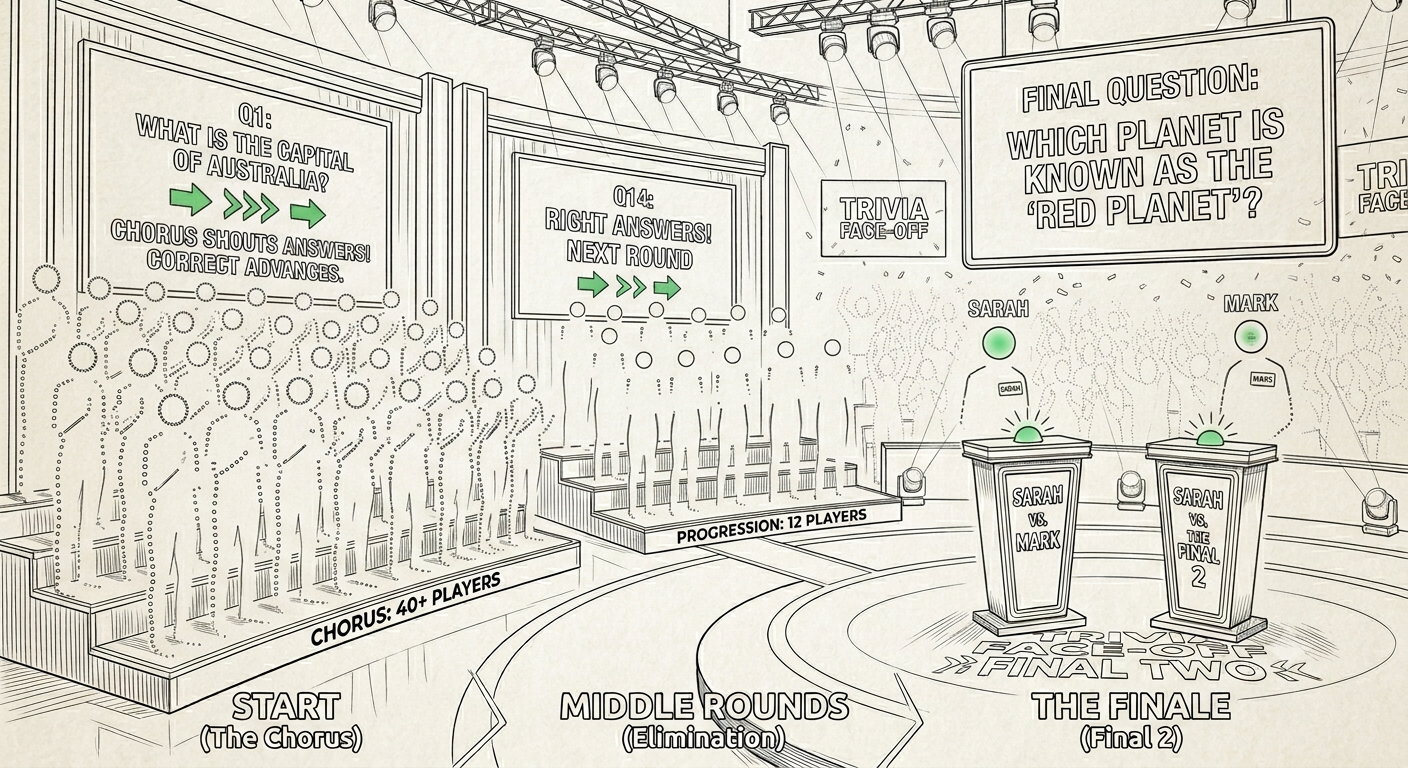
The game is a fast-paced trivia challenge designed to whittle down a massive crowd. The game kicks off with every player participating. Each Person may answer exactly 1 question. If they are correct they advance to the next round.
1. Round 1 (30 questions): About 30 players may advance
2. Round 2 (15 Questions): About 15 players may advance
3. Round 3 (about 4 questions): 2 Correct Answers needed to advance Only the First 2 players to answer 2 questions correct will advance.
4. Round 4 / The Finale (5 questions): The last two remaining players face-off to determine the winner.
=============================
- Right Answer Advances
- Wrong, (no penalty)
- No Clues
- PACE, Rapid Fire: Questions are delivered back-to-back at an intense, quickfire pace to keep the energy high and force split-second thinking. The questions budget (30, 15, etc) are not adjusted for wrong answers. For example the 30 questions pool allows for up to 30 to advance but may be fewer than 30.
Round 1 (30 Questions)
1. What are the first recorded words of God? Let there be light Genesis 1:3
2. What was the garden of Eden guarded with to prevent future access to the tree of life? A cherubim and a flaming sword (Gen 3:24)
3. What were the first words God spoke to man? Be fruitful and multiply (Gen 1:28)
4. Of what wood was Noah’s Ark made? Gopher wood (Gen 6:14)
5. How long was the ark? 300 cubits (Gen 6:15)
6. How many stories tall was the ark? three (Gen 6:16)
7. How long did the flood cover the earth? 150 days (Gen 7:24)
8. Who was punished with death for touching the ark of God? Uzza (1 Chron 13:9, 13)
9. What is the first city mentioned in the Bible? Enoch (Gen 4:17)
10. How old was Joseph when his brethren sold him into slavery? 17 (Gen 37:2)
11. Who suggested that Joseph interpret the dreams of Pharaoh? The cupbearer (Gen 41:12–13)
12. Who was Moses’s father-in-law? Jethro (Exod 3:1)
13. How old was Moses when he gave God’s message to Pharaoh: “Let my people go”? 80 years (Exod 7:7)
14. What was the first of the ten plagues in Egypt? Water turned into blood (Exod 7:20)
15. Who was David's eldest brother? Eliab (1 Sam 17:28)
16. What was the height of Goliath? In other words, how giant was this giant? Six cubits and a span (1 Sam 17:4)
17. When Saul was pursuing David, in which cave did David seek refuge? Cave of Adullam (1 Sam 22:1)
18. To whom did God promise that his children should be in numbers as the stars in heaven? Abraham (Gen 15:5)
19. Who made the first confession to the Lord, as recorded in the Bible? Jacob (Gen 32:9)
20. What was the total number of the children of Israel that went down to Egypt? 70 (Gen 46:27)
21. How long were the children of Israel in Egypt? 430 years (Exod 12:40–41)
22. How were the children of Israel guided in their forty years of wandering in the wilderness? By a pillar of cloud by day and a pillar of fire by night (Exod 13:21)
23. How long were the children of Israel captive in Babyolon? 70 years (Jer 25:11)
24. Gideon assembled 32,000 troops to confront Israel's foes, but God told him he didn't need that many. How many men did actually fight the Midianites? 300
25. Sisera, the Canaanite commander, fled and took refuge in the tent of Heber, a Canaanite ally. Heber's wife, killed Sisera in the tent. What was her name?" jael
26. Jephthah, the Judge who fought the Ammonites, pledged to God before the battle that if he triumphed, he would sacrifice the first thing he saw when he came back home. When he arrived after winning the war, what's the first thing he saw? " His Daughter (Judges 11:39-40)
27. What was the symbol of Samson's strength? never cutting his hair
28. "In the Book of Judges, how many judges are mentioned?" 16
29. "With an oxgoad, this judge killed 600 Philistines and saved Israel." Shamgar (Judges 3:31)
30. Who was the most wicked king of Israel? Ahab (1 Kgs 21:25)
Round 2 (15 questions)
1. What king’s name meant peaceable? Solomon (1 Chron 22:9)
2. Who was made king of Judah at seven years of age after having been hidden for six years? Joash (2 Chron 23:11)
3. What king did God smite with leprosy? Uzziah (2 Chron 26:19)
4. What king was on the throne of Judah when he was only eight years old? Jehoiachin (2 Chron 36:9)
5. Who was the first recorded person raised from death to life? The son of Zarephath’s daughter (1 Kgs 17:21)
6. What is the whole duty of man, according to Ecclesiastes? Fear God and keep his commandments (Eccl 12:13)
7. What queen of Bible times is described by the title “that wicked woman”? Athaliah (2 Chron 24:7)
8. What was the first prophecy? The victory over Satan of the seed of the woman (Gen 3:15)
9. What aged prophet’s hands were upheld by two persons and caused the armies of Israel to be victorious? Moses (Exod 17:12)
10. Who prophesied that Judah should be carried captive into Babylon? Jeremiah (Jer 20:4)
11. What prophet was suspended between earth and heaven by a lock of his hair? Ezekiel (Ezek 8:3)
12. What prophet was sent as a missionary to the Ninevites? Jonah (Jonah 1:1–2)
13. Who partook of a meal prepared by an angel, and was sustained forty days and nights while in the mountain? Elijah (1 Kgs 19:8–9)
14. Three men, in different periods, stood almost alone in their godliness, among a crooked and perverse generation: Job, Noah and ...? Daniel (Ezek 14:14)
15. Who beheld a vision in the valley of dry bones? Ezekiel (Ezek 37)
Round 3 (~4-8 questions, Goal is to get 2 players who answered correctly twice)
1. Where was an altar erected “to the unknown God”? Athens (Acts 17:22–23)
2. What woman continued in prayer day and night in the temple? Anna (Luke 2:36)
3. What was our Savior’s last command to his disciples? Make disciples and baptize them (Matt 28:19)
4. Which apostle told Christ he had left all to follow him? Peter (John 13:37)
5. Who took Judas’s place among the twelve? Matthias (Acts 1:23)
6. Which of the apostles first suffered martyrdom? James (Acts 12:2)
7. Who was the first Christian martyr? Stephen (Acts 7:58)
8. Who was compelled to bear the cross of Christ to the place of crucifixion? Simon (Mark 15:21)
9. Who restored Paul’s sight after the Lord blinded him? Ananias (Acts 9:17–18)
10. How did Paul escape Damascus when the Jews were trying to kill him? He was let down from the city walls in a basket (Acts 9:25)
Round 4 - Final Round (5 questions)
1. What was Paul’s occupation? Tentmaking (Acts 18:3)
2. Who was the first Christian convert in Europe? Lydia (Acts 16:14)
3. How did God manifest his presence at the dedication of the temple? Fire came down from heaven (2 Chron 7:1)
4. Name two of three occasions we are told that Jesus wept? At the grave of Lazarus, over Jerusalem, and in Gethsemane (John 11:33; Luke 19:41; Heb 5:7)
- Quote the last words of Jesus while on the cross? It is finished (John 19:30).