# Bible Introduction
# Introduction: Course Description
This course will be partly introduction and for many bible students partly a review of general information concerning the Bible. We will study peculiarities, origins, structure, meaning, and versions of the Bible.
As we are giving an overview of the Bible, we will mainly consider general facts concerning the Scriptures. Much more time and study will be given in other courses to dig into the wealth and depth of Scripture. Because there is not "one size fits all" when it comes to teaching, each Bible Student will find they already know some things and other things never heard. Even the things heard, maybe you have forgotten and this course will serve as a good review for you that are somewhat familiar with the Bible and will serve as an introduction for those of you who are not so familiar. No matter what your familiarity with Scripture, I am sure you can glean from information given in this study.
Bible Introduction is an introduction to the Holy Bible and to why we believe it is the infallible, inerrant, unadulterated, and inspired Word of God and free from contradictions.
**Bible Introduction will be organized as follows:**
### Chapter 1: General Information of the Bible
The sixty-six books of the Bible and their general contents, principal characters, places, facts and events of the Bible.
### Chapter 2: Unity of the Bible
The awesome and beautiful design of Scripture.
### Chapter 3: Inspiration of the Bible
The process by which God chose to deliver his message through the pens of holy men.
### Chapter 4: Canonization of the Bible
Answer the question, "How did we settle on the 66 books we call the Bible? Why are other old manuscripts not included in the Biblical canon and why are the Books that are included there?"
### Chapter 5: God's Word Into English
The amazing history of how God has preserved his Word through the ancient languages and then oversaw its translation into English.
### Chapter 6: Modern Versions of the Bible
A careful look at Modern Versions of the Bible with important concerns and cautions.
### Chapter 7: Imagery and Typology of the Bible# Chapter 1: General Information of the Bible
## Sections
1. [The Bible Is...](#bkmrk--7)
2. [Names of the Bible](#bkmrk--8)
3. [Purpose of the Bible](#bkmrk--9)
4. [Comparison of the Old and New Testaments](#bkmrk--10)
5. [Old Testament Overview](#bkmrk--11)
6. [New Testament Overview](#bkmrk--12)
7. [Principle Characters of the Bible](#bkmrk--13)
8. [Principle Places of the Bible](#bkmrk--14)
9. [Principle Events of the Bible](#bkmrk--16)
## 1. The Bible Is…
### The Bible is God's written Revelation of His will to men.
God wrote no other book than the Bible. There is no other physical evidence of the details of God's will and His person than the Bible. Only by reading the Bible can we be sure of so many questions regarding God.
#### Who is God?
#### What is God like?
#### What does God want?
#### What is God's plan?
#### Why does God do what He does?, Etc.
In the Bible, God has provided the details of His will and the expression of His love for humanity. All other supposed revelation must harmonize with this great Book. The Holy Bible is the standard for all life--temporal and eternal!
### The Bible is all about Salvation through Jesus Christ.
The Bible's central theme is salvation through Jesus Christ. ("central" main, chief, basic theme - a topic, as of a lecture.)
### The Bible is Translated Today from Much Older Languages
The Old Testament was originally written in Hebrew (with a small percentage in Aramaic.) The New Testament was originally written in Greek. The English King James Version is a translation from these original languages. To "translate" means to change from one language to another.
### The Bible is ONE
The Bible is one book, one history, and one story--HIS STORY \[God's Story\]! We call it the HOLY Bible because it is God's Word and not merely the story of men. The word HOLY means sacred, pure, blameless, or religious, consecrated. The Bible is a divine book yet God used people to express His Divine truths. Holy men (human element) wrote as they were moved upon by the Holy Ghost (Divine element). Because it is God's Word, we cannot dispose of one book or passage of the Bible.
The Bible has 66 books, 39 in the OT and 27 in the NT. The Divine revelation of the Bible moves smoothly from the beginning in Genesis to its ending in Revelation. Genesis is a book of origins; Revelation is a book of endings. The books of the Bible in-between are God's redeeming words to a wrecked, ruined world. Each book of the Bible has its own message, yet in its entirety a complete message of salvation to man can be seen.
## 2. Names of the Bible
### Holy Bible
The actual word bible appears nowhere within the text of the Bible. The word bible comes to us from the Greek word biblios which means "books". The word biblios was originally used to refer to the papyrus reed used in the making of ancient paper. The English word bible means "books". The Holy Bible refers to the collection of Holy books. ### The Bible's Names for Itself
#### The Book
> Genesis 5:1--This is the book of the generations of Adam.
> Psalm 40:7--Then said I, Lo, I come: in the volume of the book it is written of me, (Heb. 10:7)
> Matthew 1:1--The book of the generation of Jesus Christ, the son of David, the son of Abraham.
> Luke 4:17--And there was delivered unto him the book of the prophet Esaias. And when he had opened the book, he found the place where it was written,
#### Testament
The word testament means covenant or agreement. The Bible books under the old covenant are called the Old Testament and the Bible books under the new covenant are called the New Testament.
> II Corinthians 3:14--But their minds were blinded: for until this day remaineth the same vail untaken away in the reading of the old testament; which vail is done away in Christ.
> II Corinthians 3:6--;Who also hath made us able ministers of the new testament; not of the letter, but of the spirit: for the letter killeth, but the spirit giveth life.
#### Scripture
The word scripture means "writings". This word is used to refer to sacred writings, and is usually used in connection with the Bible. Jesus refers to the writings of the prophet Isaiah as the Scripture (Lk. 4:21). Jesus questions the chief priests and elders: "Did ye never read in the Scriptures…" (Mt. 21:42) Jesus again used this word when talking to the Sadducces: "Ye do err, not knowing the scriptures, nor the power of God". (Mt. 22:29) Other references: Lk. 24:27, Rom. 1:2, Rom. 15:4, II Tim. 3:15-16; I Peter 1:20
#### The Word of God
This is the most significant, powerful, and complete name for the Holy Bible. The Bible is the God's written and recorded word to man. The Bible is not the word of man. The Bible is the Word of God. References: Mk. 7:13, Rom. 10:17, II Cor. 2:17.
> Hebrews 4:12--;For the word of God is quick, and powerful, and sharper than any twoedged sword, piercing even to the dividing asunder of soul and spirit, and of the joints and marrow, and is a discerner of the thoughts and intents of the heart.
## 3. Purpose of the Bible
# The Purpose of the Bible
## The Bible was written that men might believe, understand, know, love, and follow Christ.
### That men might believe that Jesus is the Christ. The main theme of the Bible is redemption through Jesus Christ. The word christ means "the anointed one", and refers to the Messiah. Men need to believe that Jesus is the Savior. The Gospel is the power of God unto salvation to everyone that believes. (Rom. 1:16)
> John 20:31--But these are written, that ye might believe that Jesus is the Christ, the Son of God; and that believing ye might have life through his name.
### That men might understand who Christ is. Jesus reveals Himself through His Word. The Bible tells us that the Scriptures testify of Jesus. Men need to understand through the Word that Jesus is the messiah; He is the savior and the only source of Salvation.
> John 5:39--Search the scriptures; for in them ye think ye have eternal life: and they are they which testify of me.
### That men might know Christ. The Bible helps men to know Christ. The songwriter stated, "I'm glad I know who Jesus is!" Paul desired to know Christ in a greater way. Christians can know who Jesus is, and also know Him in a personal way sharing fellowship with Him.
> John 17:3--And this is life eternal, that they might know thee the only true God, and Jesus Christ, whom thou hast sent.
### That men might love Christ. According to the Scripture, in order for a man to love Christ he must keep the Words of Christ which are contained in the Bible. We need to study the Bible so that we can obey the Word of God and love Jesus.
> John 14:23--…a man love me, he will keep my words: and my Father will love him…
> I John 2:5--But whoso keepeth his word, in him verily is the love of God perfected…
### That men might follow Christ. The word Christian means "one who follows Christ." The Bible was written that men might follow Christ.
> John 10:27--My sheep hear my voice, and I know them, and they follow me:
> John 12:26--If any man serve me, let him follow me…
## The Bible reveals the purpose and plan of God.
### Concerning Salvation. The Bible explains that salvation is received through faith in Jesus and reveals man's need of salvation.
> John 3:16--For God so loved the world, that he gave his only begotten Son, that whosoever believeth in him should not perish, but have everlasting life.
### Concerning the Church. The plan of God for His Church is that she should be glorious, holy and without blemish. There is much instruction given to the Church in the Bible.
> Ephesians 5:27--That he might present it to himself a glorious church, not having spot, or wrinkle, or any such thing; but that it should be holy and without blemish.
### Concerning the last days. The Bible reveals God's plan for the last days. We understand from the Bible that we are living in the last days and God gave us warning of what would come to pass in these last days.
> II Timothy 3:1--This know also, that in the last days perilous times shall come.
## The Bible is God's written Word to man.
### 1. It is a sure Word of prophecy. The Bible is the infallible Word of God. It does not merely contain God's Word, but is God's Word. The Bible is a sure word in a dark hour.
> II Peter 1:19-21--For the prophecy came not in old time by the will of man: but holy men of God spake as they were moved by the Holy Ghost. We have also a more sure word of prophecy; where unto ye do well that ye take heed, as unto a light that shineth in a dark place, until the day dawn, and the day star arise in your hearts: 20 Knowing this first, that no prophecy of the scripture is of any private interpretation. 21 For the prophecy came not in old time by the will of man: but holy men of God spake as they were moved by the Holy Ghost.
### It is a solid foundation. (I Cor. 3:11) The Word of God is a solid foundation of our faith. Jesus is the Rock of our salvation. Jesus is the Word that became flesh. When everything else is sinking; the Word of God will not fail.
> I Corinthian 3:11--For other foundation can no man lay than that is laid, which is Jesus Christ.
### It is the infallible, inspired Word of God. The word inspiration means "God breathed." There is life in the Word which is the very breath of God. God's Word is without error or contradiction.
> II Timothy 3:16--All scripture is given by inspiration of God, and is profitable for doctrine, for reproof, for correction, for instruction in righteousness:
## The Bible is the final authority.
### 1. Preaching and teaching must be founded upon God's Word. (II Tim. 4:2) Paul told Timothy to preach the Word. The Word is the foundation for our faith. (Rom. 10:17) What we believe and preach must be in harmony with the Bible.
### Every question must be settled with the Word of God. The Bible must be the absolute authority in every area of question in the lives of men. The authority of the Word of God must never be questioned by the saint of God. This is why we need to know beyond all doubt that we have the Word of God today.
## 4. Comparison of the Old and New Testaments
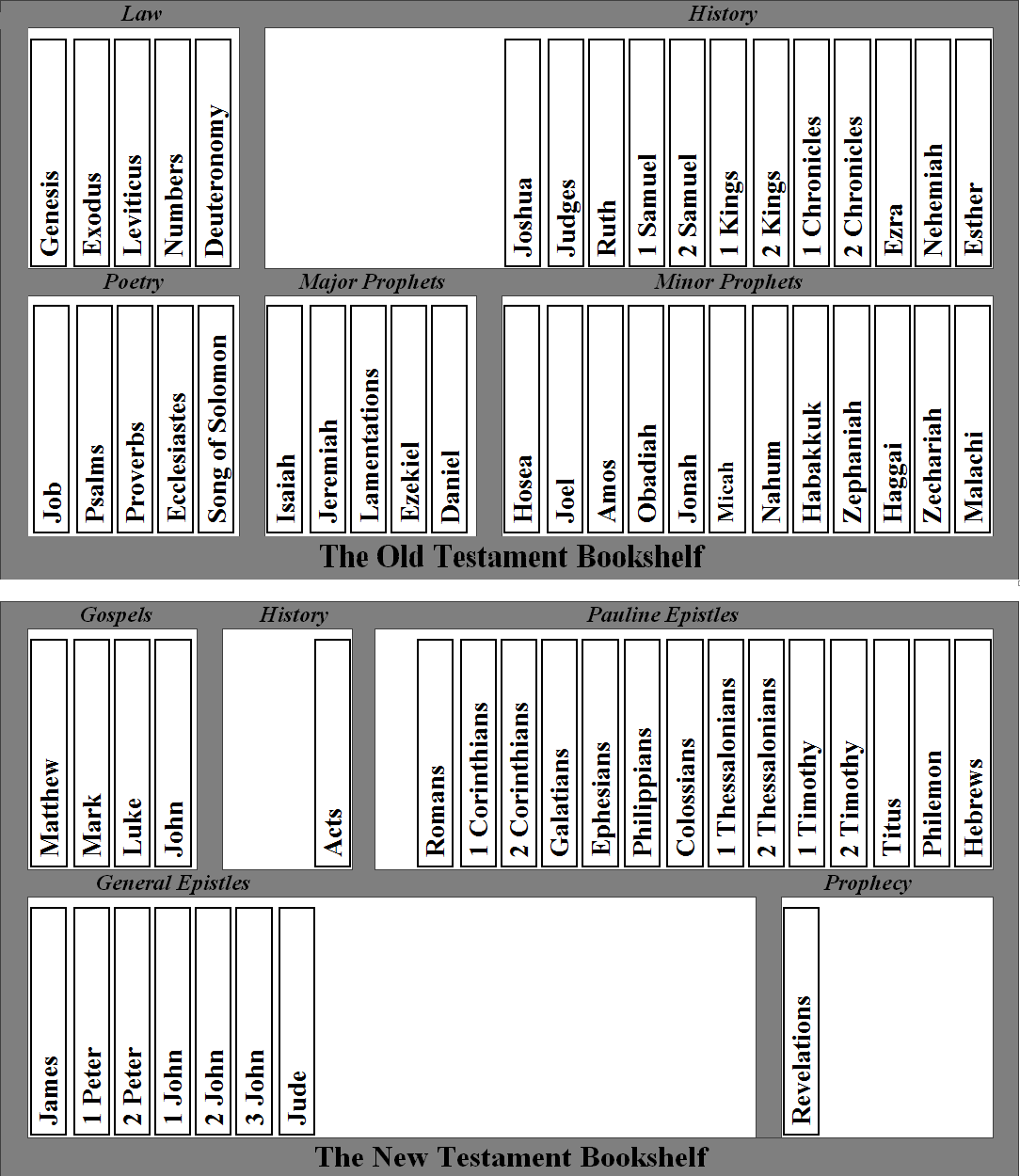## OLD TESTAMENT & NEW TESTAMENT: COMPARED
### Both begin with Divinity.
#### The Old Testament begins with God. -- Genesis 1:1
#### The New Testament begins with Christ. -- Matthew 1:1
### Both share the same theme.
#### Salvation through Jesus Christ is the central theme of both Testaments.
Romans 1:16; I Peter 1:10; Isaiah 56:1; 59:17
#### The Old Testament looks forward by faith to the cross. Redemption through the blood of Jesus was God's plan for the Old Testament, and is God's plan for the New Testament.
> Revelation 13:8--And all that dwell upon the earth shall worship him, whose names are not written in the book of life of the Lamb slain from the foundation of the world.
The plan of God since the beginning of time was for Jesus who is the Lamb of God to shed His Divine Blood to purchase our salvation.
#### The New Testament looks back at the finished work of the cross.
### Both center on Christ.
#### The Old Testament is full of prophecies of Christ. These are called Messianic Prophecies. The Old Testament contains many shadows and types that point to Christ. The law is a schoolmaster to bring us to Christ. -- Gal. 3:24 Christ is the fulfilling of the law. (Galatians 3:24; Romans 10:4)
> Matthew 5:17--Think not that I am come to destroy the law, or the prophets: I am not come to destroy, but to fulfil.
##### Christ is the predominant person of the New Testament. Jesus is the mediator of the New Covenant. -- Heb. 12:24 (Heb. 8:6; 9:15)
## 5. Old Testament Overview
# O.T. Overview
> Psalm 119:105 -- Thy word is a lamp unto my feet, and a light unto my path.
> A thorough knowledge of the Bible is worth more than a college education. -Theodore Roosevelt
> The Bible will keep you from sin or sin will keep you from the Bible. -D.L. Moody
In the front of most Bibles is an index of all sixty-six books. From this index we can find where to turn to find each book. This is an invaluable aid to the novice but should not be used as a crutch for the serious Bible student. People spend much time developing their craft and honing their skills. The Christian ought to diligently and daily improve their knowledge of the Scriptures. One way we can increase our knowledge of the Bible is to memorize the names of the Books of the Bible in their order.
## PENTATEUCH
The first five books of the Bible are called the "Pentateuch". Pentateuch means "five scrolls". These have been called the books of Moses and by the Jews "The Torah" or "The Law".
### Genesis
Genesis the book of beginnings. This book contains the account of the creation of the entire universe. It contains the record of the early history of Abraham and Israel.
### Exodus
Exodus contains Israel"s sojourn into Egypt and their deliverance from the bondage of Egypt. The Ten Commandments and Israel" journey to Canaan are also included.
### Leviticus
Leviticus is The Book of the Laws of God concerning mainly with worship and the ministry of the priesthood. Indelibly marked in Leviticus is the supreme importance of the Blood.
### Numbers
The book of Israel"s forty years of wandering in the wilderness.
### Deuteronomy
This contains a repetition or re-giving of the Laws of God.
## HISTORY
### Joshua
A record of the conquest of Canaan under the leadership of Joshua, and the division of the land among the twelve tribes.
### Judges
The history of the deliverance of the land under the Judges.
### Ruth
Story of a gentile lady who marries Boaz becoming part of the line of Christ.
### I& II Samuel
The history of Samuel and the early years of the kings Saul and David.
### I&II Kings
The early history of the kingdom of Israel and of the divided kingdom. The prophets Elijah and Elisha appear in these books.
### I&II Chronicles
A record of the reigns of David and Solomon and the kings of Judah up to the time of the captivity.
### Ezra
A record of the return of the Jews from captivity, and the rebuilding of the temple.
### Nehemiah
Describes the rebuilding of Jerusalem"s walls and re-establishing of the Law.
### Esther
Israel"s and Esther"s story of deliverance from the wicked plot of Haman.
## POETRY
### Job
Tells the story of the affliction of Job and his victory over this affliction. Probably the oldest book of the Bible.
### Psalms
A collection of poems, prayers, and spiritual songs.
### Proverbs
A collection of moral and religious discourses and instructions in wisdom.
### Ecclesiastes
Reflections on the vanity of life and man's duties to God.
### Song of Solomon
Five songs symbolizing the love between Christ and His Bride.
## MAJOR PROPHETS
### Isaiah
The great prophet of the redemption. Isaiah warns Israel not to sin.
### Jeremiah
The weeping prophet who lamented over the sins of his people. The warning to repent or face the judgment of God.
### Lamentations
An account of the lamenting of the prophet Jeremiah.
### Ezekiel
Ezekiel the prophet portrays the backslidden condition of God"s people.
### Daniel
A record of some of the events under the captivity. The book contains end-time visions and prophecies given by God to Daniel.
## MINOR PROPHETS
### Hosea
Contemporary with Isaiah and Micah. The Apostasy of Israel is the central thought of the book.
### Joel
A prophet of Judah who calls the nation to repentance. The book contains end-time prophecy and the promise of the outpouring of the Holy Spirit.
### Amos
The herdsman prophet. He denounces the sins of the people.
### Obadiah
The doom of Edom and the final deliverance of Israel.
### Jonah
The reluctant prophet who did not want to go to Nineveh as instructed by God. God got his attention in the belly of a whale and he went to Nineveh as instructed.
### Micah
This book shows the bad moral condition of Israel and Judah.
### Nahum
Foretells the destruction of Nineveh. Judah is promised deliverance from Assyria.
### Habakkuk
Written in the Chaldean period. Speaks of the providence of God in allowing judgment to come to Israel.
### Zephaniah
Contains the vision of the future glory of Israel.
### Haggai
A contemporary of Zechariah. He reproves the people for slackness in building the second temple. There is a promise of a great returning of the glory of God to the temple.
### Zechariah
He helped to stir the Jews to rebuild the temple.
### Malachi
Portrays the closing period of Old Testament history. He tells of the need for reform before the coming of the Messiah.
## 6. New Testament Overview
# New Testament Overview
## Gospels
The word Gospel means: good news. The Gospels tell the Good News of Jesus Christ. They are not biographies and do not relate every event in the life of Christ.
### Matthew. Matthew writes as 'an Israelite indeed,' a guileless converted Jew instructing his brethren. He often quotes from the Old Testament and emphasizes the Messiahship of Christ.
### Mark. Mark wrote primarily for the Romans (i.e., frequent explanations of Jewish customs). Mark is factual and action driven in style and emphasizes the Servanthood of Christ.
### Luke. Luke represents Christ as the compassionate Friend of sinners, the Savior of the world. It is the the gospel of the universal grace of God. It is addressed to the gentiles and emphasizes the Humanity of Christ with its repetition of the title "son of man."
### John. John reveals Christ as the Son of God manifested in flesh. It is a spiritual, rather than historical gospel, omitting many things chronicled by the other evangelists, and containing much more than they do in details of spiritual concepts. John emphasizes the Divinity of Christ and contains the key verse of the Bible: John 3:16.
## History
### Acts contains the record of the birth of the Church on the day of Pentecost. This is the history of the development of the early Church.
## Pauline Epistles
An Epistle is a letter. These are Holy Ghost inspired letters written to the Church.
### Romans. The main theme is justification by faith. Paul addresses Christian duties in the second half of the book.
### I&II Corinthians. Addressed to the Corinthian Church. The book deals with the cleansing of the church from error. Paul gives instruction to the church. This word still applies to the church today.
### Galatians. Addressed to the Churches in Galatia. Paul expounds on Justification by faith and warns the church about reverting to Judaism.
### Ephesians. Addressed to the Church at Ephesus. The main theme is the unity of the saints. Paul encourages unity between the converted Jews and Gentile saints.
### Philippians. Addressed to the Philippian Church. Jesus Christ is the central message.
### Colossians. Addressed to the Church at Colossae. Christ is emphasized as the head of the Church. Paul encourages the Church and also warns them against false doctrine.
### I&II Thessalonians. Addressed to the Church in Thessalonica. Paul encourages the church. These Epistles deal with the second coming of Christ.
### I&II Timothy. Paul counsels young Timothy in the ministry. Paul admonishes Timothy to preach the Word. These counsels and exhortations apply to anyone in the ministry.
### Titus. Paul deals with ministerial duties. Good works are encouraged in this Epistle.
### Philemon. A letter written by Paul to Philemon concerning the runaway slave Onesimus. Paul pleads with Philemon to forgive Onesimus who had been converted and to restore him. Paul leads by example in forgiving Onesimus and helping to care for his physical needs.
### Hebrews. This Epistle is directed to the Hebrew converts. The author is not named in the book. It was probably another of Paul"s Epistles. The epistle sets forth Christ as the messiah and His fulfillment as Prophet, Priest, And King.
## General Epistles
### James. This Epistle was probably written by James the Lord"s brother. It deals with the concept that faith without works is dead. This deals with practical religion and the character of a true Christian.
### I&II Peter Written by the Apostle Peter to encourage and strengthen the Church. The promise of the reserved inheritance is revealed in this Epistle. Peter encourages believers to receive the great and precious promises of God. This Epistle emphasizes the inspiration of Scripture. This Epistle contains a warning against false prophets.
### I,II&II John. Written by the Apostle John. God is life, light, and righteous love. A warning against error and false teachers. An admonition to walk in the truth.
### Jude. A call to contend for the faith that was once delivered to the saints. An alarm to be on guard against false teachers.
## Prophecy
### Revelation. Received by John on the Isle of Patmos in AD 100. Contains prophesies and visions concerning the last days and the end of the age.
## 7. Principle Characters of the Bible
# Principle Characters of the Bible
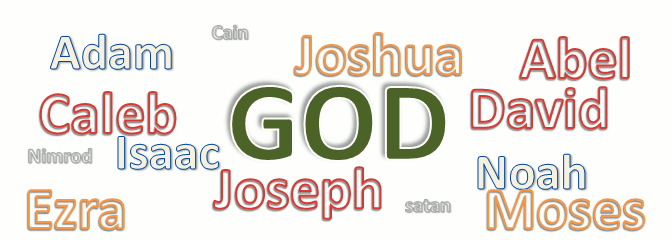### Principle Characters of the Old Testament
**God**--The Bible tells us that God is a spirit (John 4:24). God is the infinite and perfect Spirit in whom all things have their source, support and end. (Strong) God is more than a character of the Bible; God is the source of all creation. The Bible reveals God to man.
**Satan**--The word Satan means accuser. He is the Accuser of the brethren. - Revelation 12:10. Satan is also called the devil. God did not create the devil. God created the angel Lucifer who fell because of sin and became the devil. -Is. 14:12, Lk.10:18.
**Adam**--God made Adam, the first man, and placed him in the Garden of Eden. It was by him that sin was introduced into the human race. -Rom. 5:12
**Eve**--God made Eve, the first woman, from one of Adam's ribs. -Genesis 2:21-22
**Cain**--Adam's first son. He was a tiller of the ground. Cain killed his brother Abel and became the first murder. -Gen. 4;1
**Abel**--Adam's second son who was murdered by Cain. He was a shepherd. Gen. 4:2
**Seth**--Adam's third son. - Gen. 5:3
**Noah**--Built an ark to preserve life on the earth. Gen. 6:13-22
**Abram**--God called Abram to leave his home and go to an unknown land where God would make him the father of a mighty nation, thus began the history of the Hebrews. Gen. 12:1-3 God changed his name from Abram high father to Abraham father of a multitude. Gen. 17:5
**Isaac**--Son promised to Abraham in his old age and the covenant son. Gen. 17:19
**Jacob**--His name was changed by God to Israel. His twelve sons would form the tribes of the nation of Israel. Gen. 32:28
**Joseph**--A son of Jacob who was sold into Egypt as a slave. God promoted him to second in the kingdom and used him to preserve Egypt and Israel. Jacob and his family came to dwell in Goshen a district of Egypt. Gen. 37:36,42:1-3.
**Pharaoh**--The title of the ruler of Egypt. The Children of Israel became slaves in Egypt for 400 years. God hardened the heart of the Pharaoh who ruled at the time of the Exodus and delivered Israel out of Egypt with a mighty hand. Ex. 1:11-14, 6:1
**Moses**--God raised up Moses to bring the Children of Israel out of Egypt. He received the Law and the pattern for the Tabernacle on Mt. Sinai. He led Israel for 40 years. Ex. 3:10-12
**Aaron**--Brother of Moses and the first High Priest of the Levitical order. Ex. 28:1-3
**Caleb**--One of the spies Moses' sent out who brought back a good report. Nu. 13:30
**Joshua**--He was chosen by God to be the successor of Moses. Joshua led Israel in the conquest of Canaan. -Nu. 27:18-23
**Judges**--There were 15 judges that ruled Israel after the death of Joshua. Also, the name of a book in the O.T.
**Ruth**--Moabitess who returned to Bethlehem with Naomi. Her husband died in Moab before her return to Bethlehem. Ruth married Boaz and became part of Christ's lineage.
**Samuel**--Called as a boy and became one of Israel's greatest prophets. I Sam. 3:20
**Saul**--The first king of Israel. I Sam. 15:1
**David**--The shepherd boy who slew Goliath. God chose him to be king over Israel in the place of Saul. II Sam. 5:3-12
**Solomon**--A son of David and his successor as king. God granted him favor to ask for anything he chose. He prayed for an understanding heart and God made him the wisest of all men. He built the temple which became known as Solomon's Temple. I Kings 3:5-12
**Elijah**--A mighty prophet of God. He pronounced a drought upon Israel because of Sin. He prayed down fire from heaven in a showdown with the prophets of baal on Mt. Carmel. He overcame death and was taken to heaven in a fiery chariot. -II Kings 2:11
**Elisha**--The servant of Elijah who was chosen by God to take his place as prophet to Israel. I Kings 19:16
**Isaiah**--He saw a vision of God high and lifted up and the glory of God filled the temple. The prophet who warned Israel to repent or face the judgment of God. -Is. 6:1
**Jeremiah**--He was called to be a prophet of God from the womb. He was referred to as the weeping prophet who travailed over the sins of Israel. -Jer. 1:5
**Ezekiel**--He foretold the capture of Jerusalem because of their sin. -Ezk. 3:4
**Daniel**--Carried off by Nebuchadnezzar among the captives of Jerusalem. He interpreted Nebuchadnezzar's dream foretelling the progression of Empires. He received visions concerning the end times and was prominent in both the Babylonian and Persian Empires. -Dan. 1:6
**Ezra**--Priest and scribe who returned to Jerusalem to rebuild the temple. -Ezra 7:6
**Nehemiah**--He was a cup bearer who returned to Jerusalem and was a leader in the rebuilding of the temple. -Described in the book of Nehemiah.
**Esther**--The queen of Ahasuerus who was a king in a province of Persia. She was used by God to stop a plot to destroy her people the Jews. Described in the book of Esther
### Principle Characters of the New Testament
**John the Baptist**--The forerunner of the Christ. He baptized those who repented of their sins in the river of Jordan. Mt. 3:5-6
**Jesus Christ**--The only begotten Son of God. The main figure of the New Testament. The entire N.T. especially centers around the human ministry of Christ, but the entirety of Biblical revelation concerns Him in one way or another.
**The 12 Disciples**--Called and taught by Jesus; they would become the leaders of the N.T. church.
#### Peter
Peter's name was Simon (meaning "reed"), but Christ called him "Peter" meaning stone or rock. Legend says Peter was crucified on a cross like Jesus, but upside down.
#### Andrew, Peter's brother
#### James the son of Zebedee
#### John, James' brother
#### Philip (the Evangelist)
The Deacon and Evangelist (Acts 6:5; 21:8; Eph 4:11). Having four daughters who were endowed with the gift of prophecy (Acts 2:17; 21:8-9). After the death of Stephen, he preached the gospel in Samaria including to the Ethiopian eunuch with great success, and wrought many miracles.
#### Bartholomew
#### Thomas
#### Matthew the Publican
#### James the son of Alphaeus
#### Thaddaeus
#### Simon the Canaanite
#### Judas Iscariot
**Stephen**--One of the seven deacons first chosen by the church at Jerusalem, and distinguished among them as "a man full of faith and of the Holy Ghost." He was stoned to death by the Sanhedrin of which Saul of Tarsus was a member for his supposed heresy. Stephen's death was the start of an intense persecution effort led by Saul, which resulted in a greater spread of the Gospel. (Acts 8:1,4; 11:19-21)
**Paul**--Raised up to be the Apostle to the Gentiles. He was the human vessel that gave us most of the N.T. Acts 9:15
## 8. Principle Places of the Bible
# Principle Places of the Bible
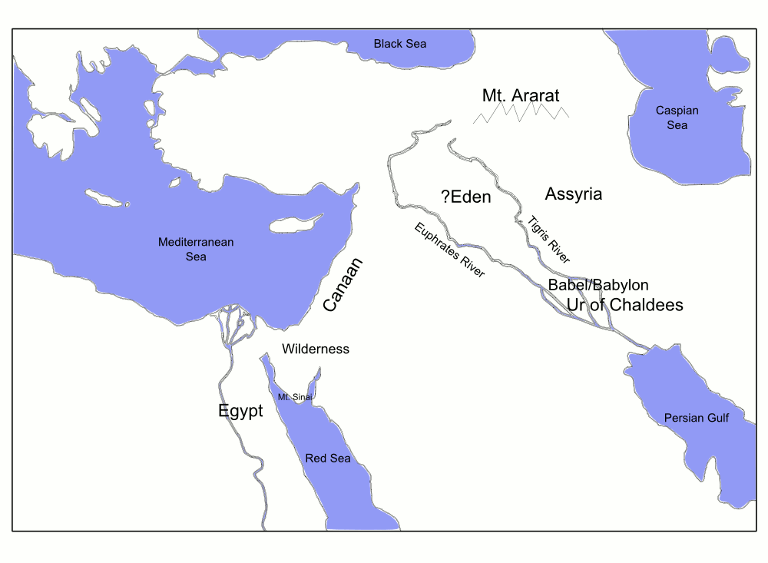
This section is intended to help the Bible student visualize the lands of Bible Times. Following will be a list of the principal places of the Bible with a brief explanation of what happened at each place. Memorizing these places and knowing what happened at each place will give you an overview of the entire Bible. Much more attention and detail is given to these Bible lands in the Bible Atlas course.
## O.T. PRINCIPAL PLACES
| NAME | DESCRIPTION | TEXT |
| Eden | God made man and placed him in the Garden of Eden. The location of the fall of man. Scripture locates Eden in the midst of four rivers. | Gen. 2:8-14 |
| Mt. Ararat | The place where Noah's ark came to rest after the flood. | Gen. 8:1-5 |
| Mesopotamia | The land between the Euphrates and Tigris Rivers. | Acts 7:2 |
| Babel | The tower was built to reach heaven and God caused men to speak in different languages. Babel means confusion. | Gen. 10:10; 11:4 |
| Ur of Chaldees | Where Abram was first called to go to Canaan. The land of what would later become Babylon. | Neh. 9:7 |
| Canaan | The Promised Land where Abraham, Isaac, and Jacob dwelt. Conquered later by Joshua and each tribe was given a portion. | Gen. 12:5 |
| Egypt | Where Joseph was sold into slavery. Israel became slaves for 400 years. Moses led Israel out of Egypt. | Gen. 12:10 |
| Mt. Sinai | Where Moses first saw the burning bush and would later receive the Law and the pattern for the tabernacle. | Ex. 19:11 |
| Wilderness | The children of Israel wandered in the wilderness for 40 years because of unbelief. | Acts 7:42 |
| Assyria | Captives of Israel were taken into Assyria. | 2 Kings 18:11 |
| Babylon | Captives of Judah were taken into Babylon. Daniel was among these captives. | Daniel 1:1 |
258. Roll Over Map Place Names for a description:
## N.T. PRINCIPAL PLACES
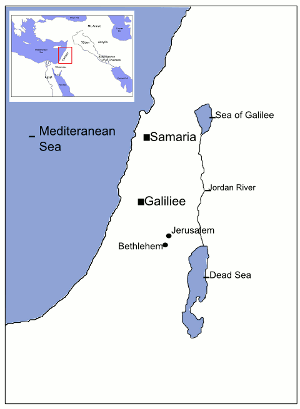
| NAME | DESCRIPTION | TEXT |
| Bethlehem | Place of the nativity--birth of Christ in a manger. | Luke 2:7 |
| Galilee | was divided into three provinces, Judea, Samaria, and Galilee, which included the whole northern section of the country (Acts 9:31), and was the largest of the three. | Luke 4:14 |
| Gethsemane | Christ's place of prayer and betrayal by Judas. | Matt. 26:39 |
| Golgotha | Location of the Christ's crucifixion. "The place of a skull." | Mark 15:22-28 |
| Jerusalem | called also: Salem, Ariel, Jebus, the "city of God," the 'holy city;"once 'the city of Judah"The location of the birth of the NT Church. | Acts 1:8 (2 Chr. 25:28) |
| Samaria | Samaria occupied the centre of Palestine but is not regarded as a part of the Holy Land at all. The distance between Samaria and Jerusalem, the respective capitals of the two kingdoms, is only 35 miles in a direct line. | John 4:1-5 |
| John Calvin | Isaiah 53:5 | C.H. Spurgeon | Isaiah 45:22 | Look unto me.…"When, for the first time, I received the gospel to my soul's salvation, I thought that I had never really heard it before, and I began to think that the preachers to whom I had listened had not truly preached it. But, on looking back, I am inclined to believe that I had heard the gospel fully preached many hundreds of times before, and that this was the difference,--that I then heard it as though I heard it not; and when I did hear it, the message may not have been any more clear in itself than it had been at former times, but the power of the Holy Spirit was present to open my ear, and to guide the message to my heart"
The minister did not come that morning; he was snowed up, I suppose. At last, a very thin-looking man, a shoemaker, or tailor, or something of that sort, went up into the pulpit to preach. Now, it is well that preachers should be instructed; but this man was really stupid. He was obliged to stick to his text, for the simple reason that he had little else to say.
''Look unto Me; I am sweatin' great drops of blood. Look unto Me; I am hangin' on the cross. Look unto Me; I am dead and buried. Look unto Me; I rise again. Look unto Me; I ascend to Heaven. Look unto Me; I am sittin' at the Father's right hand. O poor sinner, look unto Me! Look unto Me!''
Preaching one day, Spurgeon stepped to the pulpit and uttered one declaration: " Behold the lamb of God Who takes away the sin of the world. (Jn 1:29)"
Satisfied with the acoustics, he left and went his way. Unknown to him, there were two men working in the rafters of that large auditorium, neither one a Christian. One of the men was pricked in his conscience by the verse Spurgeon quoted and became a believer later that day! |
| Henry Moorhouse | Matthew 1:21 | John Williams | Mark 8:36 |
| Sir James Simpson | John 3:14,15 | W.P. Lockhart | John 19:30 |
| David Livingston | Acts 16:31 | When but nine years old he received a prize of a New Testament from his Sunday-school teacher, for repeating Psalm 119.
| William Cowper | Romans 3:25 |
| Sir George Williams | I Corinthians 15:1-4 | Martin Luther | Galatians 3:11 |
| Lord Shaftesbury | I Peter 3:18 | Hedley Vicars | I John 1:7 |
| James Chalmers | Revelation 22:17 | Robert Moffat | John 3:16 |
| Duncan Mathieson | Psalm 11 | Scottish Evangelist "worship without clarity, prayer without passion — these describe the times of Matheson's childhood church experience."
His mother died after a lengthy bout of consumption. Her dying words urged him to come to the savior, but still he resisted. One year later, he heard a message by Andrew Bonar on Psalm 11 that prompted him to re-consider the state of his soul. Shortly after he sought out a private meeting with an elderly pastor who spoke clearly and frankly to the state of his soul and his need for Christ.
"Young man, were I to say I am pleased with you, you would go down that stair in a happy frame, but you are yet far from the kingdom of God. You have never yet dealt with the justice of God. His justice in condemning you for breaking his law has never entered your thoughts. I see you are angry with God for not giving you salvation as the reward of works. But it must be grace from first to last."
On one occasion he handed out some 25,000 tracts in less than a week. Over the course of the war he would personally distribute 52,000 tracts, 622 bibles, 1,477 New Testaments in English. He gave away thousands more in French. After the war, he went to Sardinia where he distributed 2,347 Italian Bibles, 1,230 New Testaments and over 3,400 other books and tracts. Eventually he started and edited a gospel newsletter entitled, The Herald of Mercy, which would reach a monthly circulation of 32,000.
He once said, "I do not know if ten minutes of my life ever pass without thinking of the salvation of souls." | Richard Weaver | John 3:16 |
Who ever heard of anyone being made"a new creature" through Homer, Shakespeare, Scott, Dickens, Macauley, Huxley,Carlyle, Eliot, Kipling, Wells, or anyone else? Millions have been made new by reading and believing the Bible which is the Word of God.
> John 9:25 —He answered and said, Whether he be a sinner or no, I know not: one thing I know, that, whereas I was blind, now I see.
## It produces spiritual growth.
The Bible produces spiritual growth in the lives of the saints of God. The Bible is the spiritual food of theChristian and must be read daily for Christian strength and growth.
Memorizing Ecclesiastes 5:3 as child dramatically transformed my speaking habits. —Stephen Reynolds, Jr.
> Jeremiah 15:16—Thy words were found, and I did eat them; and thy word was unto me the joy and rejoicing of mine heart…
> 1 Peter 2:2—As newborn babes, desire the sincere milk of the word, that ye may grow thereby:
> 2Peter 3:18—But grow in grace, and in the knowledge of our Lord and Saviour Jesus Christ…
Martin Luther's Reformation began not when he nailed the 95 Theses to the Castle Church door, but when we discovered and Believed the Biblical Gospel. Luther's Tower Experience with Romans 1:17 was the pivotal event of his life.
My wife's describes her thrilling experiences of her first year of Bible school when God daily fed her, His Word and exhilarated her soul!
## It cleanses the life.
The Bible can cleanse the lives of men and women. The Holy Ghost will convict men through the Word. The Bible will reveal to men what needs to be changed in their lives. The laver in the Tabernacle is a symbol of the Word of God. The priests were required to wash in the laver every time they came into the service of the Lord.
> John 15:3--Now ye are clean through the word which I have spoken unto you. \[Eph. 5:26\]
> Psalms 119:9--Wherewithal shall a young man cleanse his way? by taking heed thereto according to thy word.
> 1Peter 1:22--Seeing ye have purified your souls in obeying the truth through the Spirit unto unfeigned love of the brethren, see that ye love one another with a pure heart fervently:
## It builds up the believer.
Is there any weak or sickly among you? There is strength and encouragement in the Word of God. The Word will build you up and sustain you in the difficult times. Christians can stand upon this sure foundation.
> Romans 16:25--Now to him that is of power to stablish you according to my gospel…
> Eph. 2:20 -22--And are built upon the foundation of the apostles and prophets, Jesus Christ himself being the chief corner stone; In whom all the building fitly framed together groweth unto an holy temple in the Lord: In whom ye also are builded together for an habitation of God through the Spirit
## It ends in perfection.
> Ephesians 4:11-15--11 And he gave some, apostles; and some, prophets; and some, evangelists; and some, pastors and teachers; 12 For the perfecting of the saints, for the work of the ministry, for the edifying of the body of Christ: 13 Till we all come in the unity of the faith, and of the knowledge of the Son of God, unto a perfect man, unto the measure of the stature of the fulness of Christ: 14 That we henceforth be no more children, tossed to and fro, and carried about with every wind of doctrine, by the sleight of men, and cunning craftiness, whereby they lie in wait to deceive; 15 But speaking the truth in love, may grow up into him in all things, which is the head, even Christ:
## 5. Inspiration: Deceptive Views
## The Bible was produced by natural inspiration.
This false view holds that theBible is the product of genius of a high order, but not supernatural, orDivine. This is the type of inspiration that Milton, Shakespeare, or Confucius show in their writings. No man of intelligence, however, can go from readingShakespeare to reading the Bible without feeling that the difference between the two is more than just by degree. A book can be inspiring without being inspired. The Bible far supersedes the books of men.
## God used levels of inspiration to give us the Bible.
This false view claims thatGod used different levels of control at different times in the process of inspiration. This view advocates that sometimes God used Divine inspiration and at other times, God only offered suggestions or promptings of instruction.
This is totally contrary to true Biblical inspiration.
## God only gave the concepts or thoughts to the men who wrote the Bible.
Those who promote this false view advocate that only concepts or thoughts were given by inspiration. This position leaves the wording of the text to the minds of men. This again is contrary to the correct meaning of true Biblical inspiration.
## Only portions of the Bible are inspired.
This is a dangerous false doctrine referred to as partial inspiration. This position states that the Bible contains the Word of God, but is not all of Scripture is inspired. Who then decides what is and what is not inspired? Such a theory leaves man in awful and fatal uncertainty.
## What is the correct understanding of the inspiration of the Bible?
"Verbal and plenary inspiration" is the correct view. (Will be explained in greater detail next)# Chapter 4: Canonization of the Bible
## Sections:
1. [Definition of Canon](#bkmrk-)
2. [Description of Canonization](#bkmrk--0)
3. [Determinition of the Canon](#bkmrk--1)
4. [Homologoumena, Antilegomena and Apocryphal](#bkmrk--2)
5. [Discovery of the O.T. Canon](#bkmrk--3)
6. [N.T. Testimony on the O.T. Canon](#bkmrk--4)
7. [Description of the the N.T. Canon](#bkmrk--5)
8. [Discovery of the N.T. Canon](#bkmrk--6)
9. [Various Other Canons](#bkmrk--7)
## 1. Definition of Canon
# Definition of Canonization
The process of the Bible books being gathered together into their current form is what is meant by: Canonization of the Bible. This process did not happen overnight. Remember that each individual book had to be laboriously copied by hand. The books were used and distributed by the religious leaders of the day. There were also other books written that claimed inspiration that were not included as part of our Bible. There were religious and historical books that were also in distribution at the time of this process of judging which books should be included into the Canon. This process of recognizing which books were inspired and which books were not is what we will study in this section. We will try to answer the question: How did the Bible come into its present form?
## The word Canon comes from the root word reed .
The reed was used as a measuring device. The English word is cane and the Greek word is kanon . The word canon means a rod, rule or measuring device. 3rd century church leader Origen used the word canon to refer to the rule of faith.
## The word Canon refers to the books that were judged to be of Divine origin.
### The Biblical canon is the inspired books that have been collected together in the Holy Bible. Remember the word Bible means books and the Holy Bible is a collection of Holy books. The word Canon is simply the word that is used to refer to this collection of Holy books that we call the Bible which is the inspired Word of God.
### The Old Testament Canon refers to the Old Testament books that were judged to be divinely inspired and included in the part of the Bible we call the Old Testament.
### The New Testament Canon refers to the New Testament books that were judged to be divinely inspired and included in the part of the Bible we call the New Testament.
## Canonization is the process of placing writings in the Biblical canon.
### The Divine Author gave the Scriptures to Holy men of God.
### The manuscripts were carefully copied by hand.
### The books were not collected together in their current form immediately.
### The Jewish scribes and religious leaders gathered the books together that were judged to be of Divine origin into the Old Testament Canon.
### The early church leaders gathered the books together that were judged to be of Divine origin into the New Testament Canon.
## Canonicity refers to the fact that a book has been judged to be of Divine origin and has been included in the Canon.
### Example: The Canonicity of the Book of Isaiah was recognized because it was deemed to be inspired by God.
### Canonization in this context should not be confused with the Roman Catholic usage referring to the process of making dead people saints.
## 2. Description of Canonization
```
Description of Canonization
The Old Testament Canon was divided into three categories.
```
### The Law â€" the writings of Moses.
### The Prophets â€" the writings of men who held the office of a prophet.
### The Writings â€" with the exception of Ruth and Lamentations the writingsof men who did not hold the office of a prophet. This section is also referredto as the Hagiographa in many of the Jewish texts.
## TheMasoretic Text (MT)
### The word masoretic means traditional . Masoretic Text refers to the traditionally accepted Hebrew Scriptures. The Masoretic Textswere originally controlled by a group of Jews known as the Masoretes.
### The MT is the authoritative text of the 24 books of the Jewish canon ( Tanakh or Hebrew Bible ) complete with explanatory, grammar, pronunciation and spelling notations and significant textual details. (i. , the total number of letters on a given page could be found noted in the margin of a MasoreticText. )
### The goal of the Masoretes was to wholly preserve the very form, words and meaning of the Scriptures. Any loss or change at all was inexcusable.
## TheHebrew Scriptures were preserved by the priests.
### It was a priestly duty to preserve the written revelation of theScriptures. The priests were the divinely appointed guardians and teachers ofthe Law.
> Deuteronomy31:24-26--And it came to pass, when Moses had made an end of writing the words of this law in a book, until they were finished, that Moses commanded theLevites… Take this book of the law, and put it in the side of the ark of the covenant of the LORD your God, that it may be there for a witness against thee.
The law was placed in the charge of the priests to be kept by them alongside the Ark of the Covenant. The priests were also commanded to read the law every seven years.
### The priests oversaw the task of making correct copies of the law for the use of kings and rulers.
## Great care was taken to protect and preserve the inspired manuscripts.
### Christ was faithful to His promise that the OT Scriptures would not perish.
> Matthew 5:18--For verily I say unto you, Till heaven and earth pass, one jot or one tittle shall in no wise pass from the law, till all be fulfilled.
### The scribes used various techniques to insure the accuracy of the copied manuscripts of the Hebrew text. They used tests such as counting vowelpatterns and checking for the placement of certain words within the text when checking the accuracy of a newly completed copy. The entire manuscript wouldbe discarded if it was found to contain an error.
### From the end of the first century until the Protestant Reformation, theHebrew Old Testament was preserved by the Jews.
Jewish scribes carefully copied and preserved the manuscripts of the Old Testament. Augustine said, the Jewish scribes were the librarians of the Christian Church. The earliest of these scribes were called Tannaim (teachers). They copied the text of the OT with great accuracy. The Tannaim were followed by a group of scribes called Amoraim (Expositors). These were scholars who worked not only as copyists, but also produced TheTalmud which is a book of exposition on the laws and traditions of the Jews.
### The traditional (Masoretic) text was printed at the end of the medieval period. The Psalms were printed in 1477. And in 1488 the entire Hebrew Biblewas printed for the first time.
## The burial of the Hebrew manuscripts.
The Jewish Rabbis held the copies of the HolyScriptures in great esteem. When a manuscript was too old and worn to be of any further use, they were reverently retired. It was believed to be better to give them an honorable burial than to allow the risk of them to be improperly used or profaned. This is the reason that there are only so many surviving copiesof Old Testament manuscripts.
## The division of the Hebrew text into chapters and verses.
### The division of the Scripture into verses is quite an early practice and were fixed by the Masoretic family of ben Asher about AD 900.
### This system divides the thirty-nine books of the Old Testament (as we reckon them in our English Bible) into 23,100 verses. The Hebrew text is also divided into paragraphs.
### The division into chapters was first done by Cardinal Hugh of St. Cherin 1244.
## 3. Determinition of the Canon
```
Determination of Canonization
What determined which books would be included in the Bible and which books would not be included in the Canon of Scripture? This is an important question which must be able to be answered by the serious student of the Bible. You must know beyond doubt that the Bible in its current form is THE INSPIRED WORD OF GOD.
```
## Incorrect Views on the Determination of Canonicity
### The religious leaders determined Canonicity.
Religious councils did not determine Canonicity. The councils of man can not make a book Scripture which in its own nature is not Scripture.
### Critics will assert man had to decide which books to include in the Canon therefore placing doubt on the reliability of the Bible.
### It has been argued that men chose only books that were in agreement with their religious views to be in the Canon.
This is therefore said to be the only reason for the unity and harmony of the Scriptures. The argument is that men excluded books that did not agree with their views and included only books that did agree with their views. This false view places man as the determiner of theCanon.
## CorrectViews on the Determination of Canonicity
### God determined Canonicity.
God gave to man the books that He wanted to be included in the Bible. God protected and preserved the books thatHe inspired and safeguarded their collection into the Canon.
### TheDivine Inspiration of a book determined Canonicity.
A book was included in the Canon because it was recognized to be the Divine Inspired Word of God. A book thatwas not deemed to be of Divine authority was not included as part of the Canon of Scripture.
## 4. Homologoumena, Antilegomena and Apocryphal
# Homologoumena, Antilegomena and Apocryphal
## Homologoumena means acknowledged and refers to the readily accepted books of the New Testament.
Twenty out of the twenty-seven books of the New Testament were readily and universally accepted as genuine, and called the Homologoumena. These twenty books were the fourGospels, the Acts, the epistles of Paul (except Hebrews), and the first epistles of John and Peter.
## Antilegomena means disputed and refers to the books that were not readily accepted by the church leaders and took more time to be accepted into the Canon of Scripture.
The seven books were Hebrews, II and III John, II Peter, Jude, James, Revelation. These were disputed for a time and called the Antilegomena
There were various questions with regard to the books called Antilegomena. One question was that of whether they were really written by the men who were called their authors. Hebrews bore no name of its author, and differed in style from the acknowledgedPauline epistles; II Peter differed in style from I Peter; James and Jude called themselves servants; and not apostles; the writer of II and III John called himself an elder and not an apostle. Apostolic authorship was considered an important factor in recognizing the Canonicity of a book. There were many forgeries claiming apostolic authority, therefore these books were scrutinized more carefully before they were admitted into the Canon.
Another question was that Jude recorded accounts not mentioned anywhere else in Scripture and makes mention of Enoch which was thought to be associated with the Apocrypha. The book of Revelation was not understood by many of the church leaders and therefore was questionable in their minds. These books were not at once accepted into their place in the Canon. After a deliberate examination,however, they were at last received as genuine, the very delay proving the close scrutiny which was involved in the process of Canonization. At the beginning of the fourth century they were received by most of the churches, andat the end of the fourth century they were received by all.
```
Apocryphal Books
The Apocrypha generally refers to the books placed between the Old and New Testaments and included as an addendum to some Canons.
```
These books derive their name from a Greek word, apokruphos ,which means hidden. They are called this because they are hidden and of unknownauthority.
The Roman Catholic Church accepts the Apocrypha as part of their Canon of Scripture.
The Jews regarded them as being a valuable history of their nation.
These books did not meet the basic tests of Canonicity. They were not recognized as inspired books by the Jews. They were given a place by themselvesin the sacred volume, but with the distinct statement that they were not to be regarded as of equal authority with the books of the Canon.
Some of the Church leaders also used this term to refer to any non-canonical book.
## ThePseudepigraphical Writings
This is a term applied to books deemed non canonical but claiming some kind of religious authenticity or value.
Some of the books in this category were deemed forgeries claimingApostolic origin such as the Gospel according to Thomas.
There were many books written that were not inspired, yet claimed some kind of Divine approval. The books in this category are termedPseudepigraphical Writings. This is a term that is used in many commentaries and research materials. The serious student of the Bible should at least havea basic understanding of what is meant by this term.
## 5. Discovery of the O.T. Canon
```
Discovery of the O.T. Canon
InternalCross-Referencing
```
## There is no complete historical record of the acceptance of each O. book; therefore, the narratives of theBible itself are the best historical records we have.
### The Books of the Law were accepted immediately by Israel. -Ex. 24: 3-4
### Joshua wrote in the book of the Law of God. â€"Joshua 24:26.
### Samuel's book was placed before the Lord. â€"I Samuel 10:25.
### The Book of the Law was re-established in Josiah's time. -IIKings 22:8-11,23:1-2
### Ezra and Nehemiah admonished the people to pledge allegiance to the books of the Law of Moses. â€"Nehemiah chapter 8 and 10:28-29
### Later writers recognized earlier writings as being God's authoritativeWord.
#### Daniel recognized the book of Jeremiah to be from the Lord. â€" Dan. 9:2
#### The books of the Law of Moses are mentioned in other books of the OT. -Josh. 1:8,8:31, I Kings 2:3, II Kings 14:6, 21:8, 23:25, Dan. 9:11-13, Mal 4:4
#### Solomon's writings are referred to in I Kings 4:32
#### Jeremiah mentioned Micah's prophecy from a century before. -26:17-29
## Tests of Old Testament Canonicity
There were tests used by the Jewish leaders to judge the canonicity of a book. These principals have been determined from the writers of Biblical and Church history. There was a systematic approach to the recognition of the Canonicity of a book. This section makes mention of theBiblical writers of the canonical books. These references are only in respect to the fact that they were the human tools of the Divine Author.
### Was it written by Moses?
Mosaic authorship of a book was considered a valid test of Inspiration by the Jews from time immemorial. Moses is reverenced as the great prophet of the Jews. The books that were written byMoses were considered to be of Divine origin from the earliest of the Jewish historical record. The evidence of archaeology in Palestine strongly supports this traditional view. Jesus confirmed that Moses was the human vessel who received the Law. Did not Moses give you the Law â€" John 7:19. As was already stated the Biblical account records the immediate acceptance of the books of the law as being given by God.
### Was it written by a known prophet of God?
If the book was written by a known prophet ofGod who was considered to be an oracle of God; then the book was believed to be the Word of God.
### Was its writer confirmed by acts of God?
The writer was considered to be a man of God ifhe had the witness of the power of God in his life. If the writer was considered to be a man of God then his writings were also considered to be fromGod. The sons of the prophets recognized the authority of Elisha when they saw him take up the mantle of Elijah and part the Jordan River. â€" II Kings 2:15.
### Is it in agreement with the rest of Canonical Scripture?
There must be perfect unity of Scripture. Doctrine in one part of Scripture must agree with the truths contained in other parts of Scripture. As has already been stated some will argue that books were only chosen that agreed with the views of the leaders who chose them. Yet, a book could not be considered as Canonical if it was not in agreement with the rest of the received Scripture. A book was recognized as being Canonical because it was inspired. This as we can see was not the only test of theCanonicity of a book. And obviously a book of Divine origin would not contradict another book of Divine origin.
### Does it tell the truth about God?
The book must be accurate in its description of God and the things of God. The book would be rejected as being divinely inspired if it contained error concerning theology.
### Was it accepted by the Jewish leaders as being authoritativeScripture?
Some books were accepted by the Jewish leaders as being Canonical while others were not. This is a testimony that the Jewish leaders recognized the books that were included in their Canon to be authoritativeScripture.
## 6. N.T. Testimony on the O.T. Canon
## Jesus confirmed the authority of the Old Testament Canon.
### Jesus referred to the three divisions of the OT Canon: the Law, the Prophets, and the Writings.
> Luke 24:44—…all things must be fulfilled, which were written in the law of Moses ,and in the prophets , and in the psalms , concerning me.
### It was common knowledge at the time of Christ that the OT was divided into these three sections. By mentioning these sections, Jesus was confirming the authority of the OT Canon as divided. The Jews of Jesus day would have understood that He was referring to the complete Canon (of the Old Testament) in this statement:
#### Jesus questioned the Jews: Did not Moses give you the Law? --John7:19
#### Jesus mentions the Law and the prophets. -Mt. 5:17; 22:40.
#### Psalms generally refer to the section more commonly called The Writings.
### Jesus read from the book of Isaiah. Lk. 4:17-21. Jesus referred to this passage as Scripture and thus confirmed the authority and inspiration of the text.
### Jesus would not have quoted the OT books if they were not inspired.
## The New Testament confirms the authority of the Old Testament.
### There are about 263 direct quotations from the OT in the NT. The use of these quotes in the NT indicates that they were considered to be theAuthoritative Word of God.
### Paul referred to the OT writings as Scripture. Rom. 10:11; 11:2;Gal. 3:8
## 7. Description of the the N.T. Canon
```
Description of the N.T. Canon
The New Testament Canon is divided into five categories.
```
### Gospels: Matthew,Mark, Luke, John
### History: Acts
### Pauline Epistles: Romans,1&2 Corinthians, Galatians, Ephesians, Philippians, Colossians, 1&2Thessalonians, 1&2 Timothy, Titus, Philemon, Hebrews\*
### General Epistles:(Hebrews\*) James, I&2 Peter, 1,2&3 John, Jude
### Prophecy: Revelation
## The Textus Receptus
### The Latin phrase TextusReceptus means Received Text and refers to the Greek New Testament manuscripts as they were commonly accepted by the early church. There is aclear traceable stream of the inspired text that was commonly accepted by the early church. God has preserved His Word through the ages.
### 99 % of over 5,200 manuscripts of the Greek New Testament agree with the KJV andErasmus' Greek New Testament. Less then 1% (. 08%) agree with the odd omissions and changes in the TNIV, NIV, ESV, HCSB, NASB, NRSV, NLB, CEV, NCV, NAB, andNJB. (G. Riplinger, “In Awe of the Wordâ€, 2003)
### The Textus Receptus are theMSS which were used by the Reformers. TheChristian church recognizes the twenty-seven books of the Textus Receptus as being the New Testament Canon and all other MSS that remain are so contradictory and mixed up they cannot be considered trustworthy.
## The first printed Greek New Testament
### Erasmus published a Greek New Testament text in 1516. Erasmus used every available manuscript to print his Greek New Testament. He even referred to theLatin Vulgate which he believed to be greatly flawed and corrupt to insure that he looked to every possible source. He looked to gain the pure original meaning of the Holy Spirit inspired text. Erasmus' Greek New Testament was a faithful consensus of the handwritten Greek texts which were used before the printing press. He used every manuscript available and compared them with great care to insure a correct Greek New Testament would be printed and circulated for the first time.
### Erasmus did not create the Textus Receptus ; he collected and printed. He collected the many handwritten copies of Scripture in circulation and comparing one with the other discerned a true consensus among the MSS from which he printed his N.
> We should not attribute to Erasmus the creation of a ‘received text,' but only the transmission from a manuscript text, already commonly received, to a **printed** form, in which this text would continue to prevail for three centuries. †-- Kenneth W. Clark, Greek manuscript scholar (emphasis added)
## The Holy Ghost guarded and preserved the true New Testament Text.
### God's Word will not pass away.
> Mathew24:35--Heaven and earth shall pass away, but my words shall not pass away.
> I Peter1:23--Being born again, not of corruptible seed, but of incorruptible, by theword of God which liveth and abideth for ever.
### The Holy Ghost taught the Christians which books were inspired.
> John 14:25-26--These things have I spoken unto you, being yet present with you. But the Comforter,which is the Holy Ghost, whom the Father will send in my name, he shall teach you all things and bring all things to your remembrance, whatsoever I have said unto you.
### The Holy Spirit also led the Christians as to which books were not inspired. Some books were mistakenly regarded as canonical by some of the early Christians. For example, Ireneus considered “The Shepherd of Hermes†to be inspired. The Holy Spirit would eventually fix the canon in its current form of the 27 books of the New Testament.
## The Received Text of the NT was preserved by the leaders of the Church.
### In the very beginning of the church the Apostles instructed the church as to which books were inspired and which books were not. Remember John, the last of the original Apostles, was instrumental in instructing the Church and passing on the true inspired manuscripts of the New Testament until approximately AD 100.
### The early church leaders passed on the manuscripts of theNew Testament. Ignatius and Polycarp, leaders of the early church, were taught by the Apostle John giving them direct Apostolic instruction as to the knowledge of the inspired manuscripts. Polycarp taught Irenaeus who would continue as a leader in the church. The leaders instructed their successors in the truth of God's Word.
## 8. Discovery of the N.T. Canon
```
Discovery of the N.T. Canon
There is some historical account as to the acceptance of the New Testament Canon.
```
### The first New Testament books to be assembled together were the Epistles of Paul. A collection of Paul's Epistles was in circulation at the beginning of the second century. Ignatius a leader in the second century referred toPaul's epistles as Scripture. A collection of the Pauline epistles existed atthe time Polycarp wrote to the Philippians and when Ignatius wrote his seven letters to the churches of Asia Minor about AD 115.
### The four Gospels were collected together in a compiled format sometime in the earlier part of the second century. The exact date when the Four Gospels were collected together is unknown. It is generally agreed that they must have been collected together and accepted before AD 170,because the four canonical Gospels are used by Tatian, a church leader, in his harmony of the Gospels written in AD 170. Irenæus , in his work "Against Heresies" (A. 182-88),names the four Gospels of the New Testament and refers to them as Scripture.
### The four Gospels referred to as The Gospel and the Pauline Epistles referred to as the Apostle were in circulation as separate collections in the early years of the second century. These two parts were to be connected by the Book of Acts which brought the two collections together into one collection of books. This was the beginning stages of the collecting of the New Testament books into one complete Canon.
### Before AD 200 the Epistles of Paul, theGospels, Acts, I Peter and I John were recognized as Scripture by the Christian church. The writings of Irenaeus, Clement of Alexandria, and Tertullian indicate the acceptance of these books as inspired and Canonical and accorded an authority equal to that of the Old Testament Scriptures.
### The seven remaining books, 2 and 3 John, 2Peter, Hebrews, James, Jude and Revelation, were accepted as Scripture aroundAD 300.
## A testimony within the New Testament itself.
### The Apostle Peter, shortly before he died, referred to Paul's Epistles as Scripture, and also makes mention of the rest of Scripture indicating thathe esteemed the other completed inspired books as Scripture. â€" II Peter3:15-16.
### Revelation refers to itself as a book of prophecy. â€" Rev. 1:3, 22:18,19.
## There is historical evidence of the use of the N. books by the early church leaders.
Clement of Rome (97-140) wrote much from and about the New Testament. Clement of Rome in AD 95 wrote a letter inthe name of the Christians of Rome to those in Corinth. In this letter he uses material found in Matthew and Luke.
Ignatius (AD35-116) refers to large portions of the New Testament. The Epistles of Ignatius (AD115) uses language from nearly all of the Pauline epistles. The Epistle to Polycarp mentions portions of Philipians and cites nine of the other Pauline epistles. Ignatius quotes from Matthew and also from I Peter and I John.
Polycarp (AD 69- 155) refers much to the writings of the New Testament.
## Thereis historical testimony of the acceptance of the Canon by church leaders.
Theophilus (AD 115-188}, Bishop of Antioch AD 168, refers to the evangelists and the Holy Scriptures of the New Testament.
Clement of Alexandria (AD115-188) in the latter part of the second century refers to the collection of the fourGospels as being recognized as Scripture.
### Irenaeus (AD 130-200) refers to the New Testament writings as the Holy Scriptures. He quotes from every N. book except Philemon and IIIJohn. The New Testament Canon recognized by Irenaeus was very close to what we hold today.
### Tertullian (AD 160-221) uses for the first time the termNew Testament, and calls the whole Bible the whole instrument of both Testaments.
### Eusebius (AD 260-340) in approximately AD 330 divides all the 27 books of the New Testament into the disputed and non disputed categories.
### Athanius (AD298-373), Bishop of Alexandria, in his Easter letter of AD 367 lists the 27 books of the New Testament and he used the phrase being canonized in regards to them.
## Tests of New Testament Canonicity
There were tests that were used by the early church to judge the Canonicity of a book. There were many church leaders involved at different times who judged which books were inspired and which books were not. The following four guidelines was used by these leaders in their discovery of the New TestamentCanon.
### Was the book written by an Apostle?
We understand that God is the author of the New Testament. The Apostles were some of the Holy men of God that The Divine Author spoke through. If a book could be proven to have been written by one of the original Apostles of Jesus it was considered to be of Divine origin. Much weight was put on the teaching and instruction of the original Apostles. The writings attributed to the apostles circulated amongst the earliest Christian communities.
### Was the book approved by an apostle?
It was believed that the original Apostles would know which books were inspired and which books were not. A book not written by an Apostle that had Apostolic approval was considered to be of Divine origin.
### Was the book universally accepted by the early church by the end of the fourth century?
There were certain books that were accepted almost immediately by the early church as being Divine Scripture. These books were readily included in the Canon. There were other books that took time to be accepted by the church as being Canon.
### Was the book read publicly when the early church gathered for theLord's Supper?
We have historical records from the early church leaders that indicate which books were read at church gatherings. These books were used by the church because they were considered to be inspired.
### Was the book consistent with the rest of accepted Scripture?
As has been stated in regards to the acceptance of Old Testament Scripture that a book must be in perfect harmony with the rest of the accepted Canon. Even so the New Testament books that were received must also be in harmony with both the Old Testament Canon and the New Testament Canon of Scripture.
## 9. Various Other Canons
```
List of Various Canons
Different Canons have been listed by different religious groups and church leaders throughout history.
```
## The Jewish Canon
The Jewish Canon is composed of the 39 books of the Old Testament.
## The Samaritan Canon
# The Samaritan Canon is the smallest Bible in the world recognizing only the fivebooks of the Pentateuch.
## The Marcion Canon
Marcion was the first to compile alist with some of the New Testament books. Marcion rejected the Old Testament entirely and regarded the God of the Old Testament as inferior to Jesus. Marcion's Canon comprised ten of the Pauline epistles (without the Pastorals)and Luke's Gospel. He edited these books to agree with his warped teaching.
Even though he was false the rise of false teaching made the church more aware of the need to define a true Canon of Scripture.
## The Muratorian fragment Canon
The Muratorian fragment lists aCanon of New Testament books. The Muratorian fragment which is an ancient archeological manuscript dating back around AD 200 lists a Canon of NewTestament books. It is not fully readable and therefore is referred to as a fragment. It recognizes all the books except Hebrews, James, II Peter, andIII John. There is also a question as to whether I Peter is mentioned. It includes one book, the Apocalypse of Peter which was later rejected as being canonical.
## The Tertullian Canon
Tertullian (AD160-221) had 22 books in his NT Canon which included the four Gospels, Acts, the thirteen epistles ofPaul, I Peter, I John, Jude and Revelation. He did not treat Hebrews asCanonical.
## TheOrigen Canon
Origen (AD. 185-254) acknowledged the four canonical Gospels, Acts, the Pauline epistles and Hebrews, I Peter, IJohn and Revelation as undisputed books. Origen acknowledged that Hebrews, IIPeter, II and III John, James and Jude as disputed books.
## The Eusebius Canon
Eusebius (AD 260-340) isconsidered a church historian. He provides us with a full statement in whichhe explains the position of the Church at large. He makes an importantdistinction between homologoumena (recognized books) and antilegomena (disputed books). The recognized books are the Gospels, Acts, the epistles ofPaul including Hebrews, I Peter, I John, and Revelation. He divides the disputed books into two sub-classes: (1) those that ought to be included in the canon â€" James, Jude, II Peter, II and III John (2) those that ought not to be included -- the Acts of Paul, the Shepherd of Hermes, the Apocalypse of Peter,the Didache, Barnabas. He also questioned the inclusion of Revelation based on some uncertainty as to apostolic authorship. Apart from his hesitation onRevelation Eusebius' New Testament is identical to ours.
## TheAthanius Canon
Athanasius (AD 298-373) Athanasius lists the 27 books of our New Testament.
## The Roman Catholic Canon
The Roman Catholic Church includes the 66 books of our Bible and also accepts the Apocrypha as part of their Canon of Scripture. This is the same Canon as Jerome's who produced the Latin Vulgate which is the basis for the Roman Catholic Bible.
## The Recognized True Canon of the Christian Church
The true Canon consists of the 39Old Testament books and the 27 New Testament books of the Bible.
## The Luther Canon
Martin Luther listed the 27 books of our New Testament except he regarded four books as being questionable. He placed Hebrews, James, Jude and Revelation at the end of his New Testament in a detached position.# Chapter 5: God's Word Into English
## Sections:
1. [Timeline of the English Bibles](#bkmrk-)
2. [The Bible In Languages that would Later Develop into English](#section-two)
## 1. Timeline of the English Bibles
Progression of the Bibles
English Bibles have been in agreement with each other and the RECEIVED TEXT from the Gothic to the KJV.
**The Wycliffe Bible.**
John Wycliffe translated a hand written copy of the complete Bible into English. This project took several years to complete which was finished approximately in 1380.
The Wycliffe Bible predates Erasmus Greek NT so he could not have had access to it. Yet the Wycliffe Bible is in perfect harmony with Erasmus' Greek NT indicating that the then common received Greek text available to Wycliffe was the same commonly received text which was the basis for Erasmus' Greek NT.
Wycliffe also used the original language manuscripts of Hebrew and Greek.
Wycliffe did not use the corrupt Latin Vulgate as the basis for his translation.
The Catholic Church tried many times unsuccessfully to stop the work of Wycliffe.
**The Tyndale New Testament**
Tyndale also followed the Pre-Wycliffe and Wycliffe Bibles closely. The Wording of the Tyndale NT is similar to that of the Wycliffe Bible.
In 1525-1526 the Tyndale New Testament became the first printed edition of the Scripture in the English language. There are two copies still in existence today of this Tyndale first edition NT.
Tyndale used the very simple popular language of the people. Tyndale himself realized there would one day be a need for a fuller translation with deeper vocabulary.
A law punishable by death was enacted in 1530 that forbid owning or selling an English Bible. Foxe describes person after person, burned at the stake for owning the Scriptures in English.
Tyndale's final prayer before he was burned at the stake in October of 1536 was: O Lord, open the King of England's eyes. This prayer would be answered just three years later in 1539, when King Henry VIII finally allowed, and even funded, the printing of an English Bible known as the Great Bible.
**The Coverdale Bible**
Myles Coverdale had worked with Tyndale on the OT Translation into English. Coverdale finished translating the OT and in 1535 he printed the first complete Bible in the English language.
THIS WAS THE FIRST COMPLETE BIBLE TO BE PRINTED IN ENGLISH!
The Coverdale Bible consisted of Tyndale's NT and the portions of the OT that were completed by Tyndale. It was the work of Tyndale with Coverdale finishing the uncompleted portions of the OT.
Coverdale who worked with Tyndale also used the Pre-Wycliffe and Wycliffe Bibles. The Coverdale Bible is in agreement with earlier English Bibles and the KJV.
**The Great Bible**
This was the first English Bible authorized for public use. Coverdale was hired by Cranmmer the Archbishop of Canterbury at the request of Henry VIII to publish a Bible.
It was called the Great Bible due to its size. It was a pulpit version measuring over 14 inches tall. It was published in 1539.
It was not just a reprint of the Coverdale Bible. Coverdale polished and refined the Tyndale Bible. The Great Bible was another step to the KJV.
**The Geneva Bible**
The Geneva Bible is so named because it was produced in Geneva by exiles from England. It was published in 1560.
It was based on Tyndale's Bible and is almost identical to the KJV.
The Geneva Bible was the first Bible taken to America. It was the Bible of the Puritans and Pilgrims. It is truly the Bible of the Protestant Reformation.
The flaw of the Geneva Bible was the marginal notes were written by John Calvin and his assistants. The notes are strong Calvinistic and promote the false doctrines of eternal security and the predestination.
**The Bishops' Bible**
Archbishop Parker along with other bishops produced in 1568 what is referred to as the Bishops' Bible. It is so called because it was produced by the Bishops of the Church of England.
The Bishops' Bible was produced to conform to the structure of the Church of England, and to stand against the false notes of Calvinism contained in the Geneva Bible.
It followed the common English translation. Most of the text is Tyndale's and it is very similar to the KJV.
The Bishops' Bible improved on the word order of earlier versions. The words were the same, but syntax was improved for clarity. This Bible was one of the main sources for the KJV.
## 2. The Bible In Languages that would Later Develop into English
# The Bible In Languages that would Later Develop into English
## The Gothic language was an early predecessor of the English language.
### Gothic is an early root of the English language.
### Ulfilas also called Wulfila the Apostle translated the Bible into Gothic in AD 350.
### We start with this primitive root of the English language to show the clear stream of English Bible translation from the Hebrew Masoretic text and the Greek TEXTUS RECEPTUS. The Gothic Bible is in perfect harmony with the KJV and the RECEIVED TEXT.
## Anglo-Saxon is another step of the English language.
### This language is referred to as Old English.
### There is much historical evidence to show the use of Anglo-Saxon Bibles as early as the 6th century. Portions of these texts still remain today.
### The Wycliffe Bible states in the preface that the Bible had been translated into Saxon by Bede a seventh century theologian thus adding more historical support for the existence of at least portions of the Bible in Anglo-Saxon
## Middle English developed from Old English during the 12th through the 14th centuries.
### This pre-Wycliffe Bible English is another step in the development of the modern English language.
### There is archaeological evidence to support the existence of at least part of the English Bible before the Wycliffe Bible of 1389.
### Wycliffe in his preface mentions that he had gathered many older English Bibles.# Chapter 6: Modern Versions of the Bible
## Sections
1. [Two Streams of Bible Transmission](#bkmrk-)
2. [Biblia Hebraica](#bkmrk--0)
3. [Verity of the Claim of More Accurate Manuscripts](#bkmrk--1)
4. [Jerome's Latin Vulgate](#bkmrk--2)
5. [The Vaticanus and Sinaiticus](#bkmrk--3)
6. [Defense of the King James Version](#bkmrk--4)
7. [A Closer Look at the NIV](#bkmrk--5)
## 1. Two Streams of Bible Transmission
The modern versions differ in meaning from the King James Version.
Now I beseech you, brethren, by the name of our Lord Jesus Christ, that ye all speak the same thing, and that there be no divisions among you; but that ye be perfectly joined together in the same mind and in the same judgment.
> Jeremiah 23:36--And the burden of the LORD shall ye mention no more: for every man's word shall be his burden; for ye have perverted the words of the living God, of the LORD of hosts our God.
The new modern versions pervert the truth of THE WORD OF GOD!
### a. There are two historical streams of Bible Manuscripts.
The manuscripts that came out of Antioch which are the source of pure Bibles and the KJV.
The manuscripts that came out of Alexandria which are the source of corrupted Bibles and the new modern versions such as the NIV.
Ninety-five percent of the existing manuscript evidence can be traced to the pure texts from Antioch and is in agreement with the KJV.
### b. The pure stream of Antioch.
13. Antioch which was located in Syria is the first place the saints were referred to as Christians.
14. The texts from Antioch are known as the Syrian or Byzantine text.
15. These manuscripts from Antioch are those that were received by the majority of the Christian church and referred to as the Received Text.
### c. The polluted stream of Alexandria.
17. Alexandria is located in Egypt. It was a seat of false worship and pagan philosophy.
18. These Alexandrian texts were the source of Wescott and Hort's corrupt Greek New Testament and Jerome's Latin Vulgate.
19. The manuscripts from Alexandria were produced by Origen, Clement of Alexandria and other infidels who did not believe in the Divine inspiration of Scripture.
THERE ARE ONLY TWO STREAMS OF BIBLES: THE DEVIL'S STREAM FROM ALEXANDRIA, AND GOD'S STREAM FROM ANTIOCH!
## 2. Biblia Hebraica
### Rudolph Kittel
- Mr. Kittel produced a New Hebrew Old Testament text in 1909.
This text is referred to as Biblia Hebraica
The devil had already produced a new Greek text and was again at work to change and twist the Hebrew text of the pure Bibles.
This text differed from the traditionally accepted Hebrew Masoretic text used by the KJV translators.
- "Rudolph Kittel was Anti-Semitic"
### This false Hebrew text was used as a source for the new modern Bibles.
The NIV used the Biblia Hebracia for the Hebrew translation of the Old Testament.
The New King James Version primarily uses the 1967/ 1977 Stuttgart edition of Biblia Hebraica, which was another publication of Kittel's Hebrew text.
The new modern versions looked to this distorted text as a source for their translations.
## 3. Verity of the Claim of More Accurate Manuscripts
# The Lie of New More Accurate Manuscripts
## KJV critics claim there have been new more accurate manuscripts found since 1611 that were not available to the KJV translators.
### It is true that there have been new manuscripts found since 1611. It is not true that they are more accurate than the Received Text of the KJV.
### Even though there have been new manuscripts found since 1611, there have been no new renditions of the manuscripts that were then available to the KJV translators.
### The Sinaiticus was not available to the KJV translators, but the similar Vaticanus was available and rejected by the KJV translators
## The discovered manuscripts support the Received Text and the KJV.
### The recently discovered manuscripts support the accuracy of the Received Text and the KJV.
### There are no readings available today which were not already in the hands of the King James translators.
### The newly discovered manuscripts add to the volume of the majority texts of Antioch.
## The truth about the Dead Sea Scrolls.
### The Dead Sea scrolls were found in the Qumran caves near Jericho in 1947. KJV critics claim these were older manuscripts not available in 1611 to the KJV translators.
### The fact is these manuscripts are in total agreement with the Received Text and the KJV.
### The Isaiah Scroll dated at 100 BC is the now oldest available manuscript and is in perfect harmony with the book of Isaiah in the KJV. So the truth of the matter is the oldest manuscripts support the KJV.
## 4. Jerome's Latin Vulgate
# Jerome's Corrupt Latin Vulgate
## Jerome was commissioned by Pope Damasus I to produce a Latin Bible for the Roman Catholic Church in AD 382, this Bible is referred to as Jerome's Latin Vulgate.
### Jerome admitted to altering the text in his preface to the Latin Vulgate.
### Jerome's Vulgate is the source of the corrupt Catholic Douay version of the Bible produced in 1609.
### Jerome may have consulted the Alexandrian manuscripts of Eusebius since they were in existence prior to the Latin Vulgate. )
### Wycliffe did not use the corrupt Latin Vulgate.
### Erasmus rejected Jerome's Latin Vulgate.
### Tyndale used Erasmus Greek text and the Wycliffe Bible, not the Latin Vulgate which does not agree with Tyndale's work.
### The KJV translators had access to Jerome's Latin Vulgate, BUT THEY REJECTED IT AS FALSE!
## Jerome used the Alexandrian Manuscripts for the Latin Vulgate.
### The Vulgate agrees with the existing manuscripts Vaticanus and Sinaiticus which are two of the Bibles of Constantine.
### Jerome's Vulgate became the basis for many of the new modern Bible versions. .
### Jerome altered his text to conform to the paganism of the Roman Church.
## Anthony Hort and Brooke Wescott created a New Greek NT text in 1875.
### This corrupt Greek text is one of the sources of our modern Bibles.
### These men were involved in the Catholic Church and the occult, they did not believe in the infallibility of the Scriptures, and held many philosophies that are contrary to the Bible.
### They followed the pagan minority manuscripts of Alexandria that agreed with their pagan philosophy.
## Wescott and Hort used the Vaticanus and Sinaiticus manuscripts for their New Greek text.
### They rejected the Textus Receptusand chose to use the corrupt minority manuscripts of Alexandria.
### The new versions supported by this Greek text stem from the paganism and idolatry of Egypt.
### The devil used these men to attempt to undermine the KJV and promote the new false perversions of the Bible.
## This perverted Greek NT was the foundation for the English Revised Version, the American Standard Version, and other new modern Bible versions.
### Wescott ansd Hort used their new perverted Greek text as the foundation for the Revised Version New Testament which was published in 1881
### The Revised Version Old Testament published in 1885 follows the corruption of Jerome and the Alexandrian manuscripts.
### This was the first major attack by the devil on the pure King James Version of the Bible.
## 5. The Vaticanus and Sinaiticus
# The Deception of the Vaticanus and Sinaiticus
## The Vaticanus manuscript was found in the Vatican library in 1481.
### The King James translators rejected the Vaticanus because it was corrupt and did not agree with the Majority Texts of Antioch.
### Large portions of Scripture are missing from this manuscript:
### The Vaticanus came from the corrupt Alexandrian text
## The Sinaiticus was found in a garbage can in St. Catherine's Monastery on Mount Sinai in 1844 by Constantine Tischendorf.
79. Tischendorf, who discovered the Sinaiticus manuscript, noted at least 12,000 changes that had been made on this manuscript by others than the original copyist.
80. It also omits large portions of Scripture which are contained in the majority texts of Antioch.
81. This again is a Catholic manuscript and is a relative text to the Vaticanus.
## These corrupted manuscripts can be traced to the corrupt manuscripts of Alexandria.
83. Constantine, the first historical Pope, commissioned Eusebius to make 50 Bibles in AD 331. Eusebius was a follower of Origen and used the Alexandrian texts as the source for these Bibles.
84. It is believed by many scholars that the two corrupt Catholic manuscripts the Vaticanus (codex B) and the Sinaiticus (Codex Aleph) are two of these Bibles that were created by Eusebius.
85. Vaticanus and Siniaticus disagree with the true manuscripts of Antioch.
## 6. Defense of the King James Version
### a. The Preservation of God's Word into English
The King James Version which is also called the Authorized Version is the Word of God preserved and translated into English.
> The words of the LORD are pure words: as silver tried in a furnace of earth, purified seven times. Thou shalt keep them, O LORD, thou shalt preserve them from this generation for ever. - Ps 12:6-7
God promised to preserve His Word for ever.
> Heaven and earth shall pass away, but my words shall not pass away.-- Mt. 24:35
God has kept His promise and preserved His Word in the English language.
Not every modern English version is the pure Word of God.
God guarded the translation of His Word into English.
### The word translation means that which is produced by turning words and phrases from one language into another language.
### God is able to keep His Word pure and complete even through the process of translation.
### Men paid the price with their very lives to preserve and pass on the Scriptures.
## The KJV is the pure Word of God in the English language.
### There is a pure stream of transmission from the Hebrew MASORETIC TEXT, the Greek RECEIVED TEXT, and the early English Bibles to the KJV.
The word Masoretic means traditional. This refers to the traditionally accepted Hebrew Text.
The Latin word Textus Receptus means received text and refers to the commonly accepted Greek Text of the New Testament.
### The KJV does not merely contain God's Word; it is God's Word.
### b. The Commission of King James to Translate the Bible into English
## The newly crowned King James convened the Hampton Court Conference in 1604.
### The conference consisted of church leaders gathered to address problems in the church.
### The Puritan president of Corpus Christi College, John Reynolds made a motion for a new translation of the Bible.
### A plan was formed to search out the best learned men to work on this translation.
## The resolution of King James:
> That a translation be made of the whole Bible, as consonant as can be to the original Hebrew and Greek; and this to be set out and printed, without any marginal notes, and only to be used in all churches of England in time of divine service.
### A resolve was made to keep the translation to the meaning of the original Hebrew and Greek.
### There were to be no marginal notes included in this translation.
### This was to be the standard Bible for the Church of England used in all times of Divine service.
## Translators were appointed by King James to complete the work.
### King James sought out the best qualified men. These men were the best Biblical scholars and language experts of their day. Many of them spoke several languages fluently.
### Strict guidelines were set for the process of translation.
### The King James Version was published in 1611.
THE KJV IS THE PURE WORD OF GOD, PRESERVED IN THE ENGLISH LANGUAGE!
## 7. A Closer Look at the New International Version (NIV)
- The first NIV was published in 1978.
### The NIV is based on the Sinaiticus and the Vaticanus and on the Biblia Hebracia.
### The NIV lists Kittel's Theological Dictionary as a reference source.
### The NIV has been endorsed by the Catholics and is promoted as an accepted translation for Roman Catholics to use.
## The NIV adds and takes away from the Word of God.
### God gives warning to those who take away the word of God.
And if any man shall take away from the words of the book of this prophecy, God shall take away his part out of the book of life, and out of the holy city, and from the things which are written in this book.
### The NIV completely takes away 17 key verses and removes 64,576 words. That is approximately 8% of God's Word that is taken away.
## The new 2011 NIV Edition is moving toward a gender neutral version.
### This edition has been rejected by several denominations because of the gender inclusive wording.
### There have been some corrections made in some verses while changes have been made in others.
### This is a move towards a homosexual gender neutral version.# Chapter 7: Imagery and Typology of the Bible
# Study Questions
# SQ: Chapter 1
Chapter 1 Study Questions SWAHILI
Complete the following statement: "The Bible is God's written revelation of…"
"His will to men."
Other than the Bible, How many books did God write?
NONE.
Find and write out a Scripture that expresses what God is like. Follow the Scripture with a statement of your own clarifying what the verses tells us about what God is like.
i.e., Ex. 20:5; Matthew 23:37; John 3:16;
Find and write out a quote from some non-biblical writer illustrating the fact that the Bible is the standard for all life.
i.e., "The apex of creation and the key figure in earthly history, man, has been made the image of this holy God and has God's law imbedded in his heart. Man's life and purpose take their direction from God…"--Dr. Greg L. Bahnsen
What is the Bible's CENTRAL THEME?
The Bible's central theme is salvation through Jesus Christ--REDEMPTION.
In what three ancient languages was the Bible originally written?
Hebrews, Aramaic, Greek
What does "translate" mean?
To translate means to change from one language to another.
Why can't we dispose of a single book or even passage of the Bible?
Every book, verse is equally God's Word.
The only Book God ever wrote is given 5 different titles. What are these 5 names?
Holy Bible, The Book, Testament, Scripture, The Word of God
With what do both the O.T. and the N.T. begin?
Divinity. The plan of God for His Church is that she should be glorious, holy and without blemish.
Give scripture reference that reveals the mediator of the New Covenant.
Jesus Heb. 12:24; Heb. 8:6; 9:15
List the 5 categories that the Old Testament books fall into.
Law, History, Poetry, Major Prophets, Minor Prophets
List the 5 categories that the New Testament books fall into.
Gospels, History, Pauline Epistles, General Epistles, Prophecy
Fill in the following blanks: "The Bible was written that men might ______, ______, ______, ______, and ______ Christ.
believe, understand, know, love, follow
According to Ephesians 5:27, what is God's will concerning the Church?
Complete the following statement, "The Bible does not merely contain God's Word…"
"…but is God's Word.
Explain what we mean when we say, "The Bible is the Final Authority".
It is the standard by which all truth is judged. If man"s ideas contradict the Bible, man is wrong and the Bible is right.
Memorize the general locations on a map the following O.T. places: Mesopotamia, Canaan, Egypt, Mt. Sinai, Wilderness
Memorize the general locations on a map the following N.T. places: Bethlehem, Galilee, Jerusalem, Samaria
Did you complete the written Assignment under Ch. 1 Section 5 "Principle Characters of the Bible"? Yes or No.
Do a personal Study and write 300 to 600 word report on David. Be sure to include some scriptures and note any references to Scriptures you gleaned
from.
Did you complete the written Assignment under Ch. 1 Section 6 "Principle Events of the Bible"? Yes or No.
Briefly Describe from memory (after study) the following O.T. books: Leviticus, Joshua, Ezra, Ecclesiastes, Daniel, Nahum, Zechariah
Leviticus. The Book of the Laws of God. Joshua. A record of the conquest of Canaan under the leadership of Joshua, and the division of the land among the twelve tribes. Ezra. A record of the return of the Jews from captivity, and the rebuilding of the temple. Ecclesiastes. Reflections on the vanity of life and man's duties to God. Daniel. A record of some of the events under the captivity. The book contains end-time visions and prophecies given by God to Daniel. Nahum . Foretells the destruction of Nineveh. Judah is promised deliverance from Assyria. Zechariah. He helped to stir the Jews to rebuild the temple.
Briefly Describe from memory (after study) the following N.T. books: Acts, Hebrews, Jude
Acts contains the record of the birth of the Church on the day of Pentecost. This is the history of the development of the early Church. Hebrews. This Epistle is directed to the Hebrew converts. The author is not named in the book. It was probably another of Paul's Epistles. The epistle sets forth Christ as the messiah and His fulfillment as Prophet, Priest, And King. Jude. A call to contend for the faith that was once delivered to the saints. An alarm to be on guard against false teachers.
# Extras
# Passing this Course
## General Course Criteria:
Each grade will be measured:
- Completing all assignments.
- Attend every lesson.
- Maintain a passing grade-average
- Memorize Scripture
## How Your Grade will be Calculated
- ATTENDANCE 30 %
- HOMEWORK 20 %
- STUDY QUESTIONS 15 %
- BRAINSTORM 25 %
- FINAL EXAM 10 %
- Passing Grade 80%+
NOTE 1: A year-end grade of 80% or higher will be required to pass this course.
NOTE 2: Assignments handed in late will be penalized with a minimum of five marks.
NOTE 3: By the end of this course, You will list by memory all the names of the books of the Bible in order.
# What are the Books of the Bible?
# The 66 Books of the Bible
The Holy Bible is a collection of 66 books. What are the books of the Bible?
The books of Bible were not written all at once but were written by 40 different authors over the course of thousands of years. The Bible is divided into 2 halves called "Testaments". The Old Testament contains 39 books and the New Testament has 27 books.
## Simplified List of the Books of the Bible
- Old Testament (39)
- **Torah/Pentateuch**
- Genesis, Exodus, Leviticus, Numbers, Deuteronomy
- **History**
- Joshua, Judges, Ruth, 1 Samuel, 2 Samuel, 1 Kings, 2 Kings, 1 Chronicles, 2 Chronicles, Ezra, Nehemiah, Esther
- **Poetry**
- Job, Psalms, Proverbs, Ecclesiastes, Song of Solomon
- **Prophecy**
- Job, Psalms, Proverbs, Ecclesiastes, Song of Solomon
- New Testament (27)
- **Gospels**
- Matthew, Mark, Luke, John
- **History**
- Acts
- **Paul's Epistles**
- Romans, 1 Corinthians, 2 Corinthians, Galatians, Ephesians, Philippians, Colossians, 1 Thessalonians, 2 Thessalonians, 1 Timothy, 2 Timothy, Titus, Philemon
- **General Epistles**
- Hebrews, James, 1 Peter, 2 Peter, 1 John, 2 John, 3 John, Jude
- **Prophecy**
- Revelation
Here is a complete list of the books of the Bible with a brief description for each:
## Old Testament books of the Bible
The books within each testament are also grouped according to a type. For example, the first 5 books of the Bible are "The Law" or the "Torah". The Greek title for these first 5 books is "Pentateuch" which means "5 scrolls or books".
### The Law / Torah / Pentateuch:
Genesis, Exodus, Leviticus, Numbers, Deuteronomy
1. Genesis
Genesis answers two big questions: “How did God’s relationship with the world begin?” and “Where did the nation of Israel come from?”
2. Exodus
God saves Israel from slavery in Egypt, and then enters into a special relationship with them.
3. Leviticus
God gives Israel instructions for how to worship Him.
4. Numbers
Israel fails to trust and obey God, and wanders in the wilderness for 40 years.
5. Deuteronomy
Moses gives Israel instructions (in some ways, a recap of the laws in Exodus–Numbers) for how to love and obey God in the Promised Land.
### Books of History in the Old Testament
Joshua, Judges, Ruth, 1 Samuel, 2 Samuel, 1 Kings, 2 Kings, 1 Chronicles, 2 Chronicles, Ezra, Nehemiah, Esther
6. Joshua
Joshua (Israel’s new leader) leads Israel to conquer the Promised land, then parcels out territories to the twelve tribes of Israel.
7. Judges
Israel enters a cycle of turning from God, falling captive to oppressive nations, calling out to God, and being rescued by leaders God sends their way (called “judges”).
8. Ruth
Two widows lose everything, and find hope in Israel—which leads to the birth of the future King David.
9. 1 Samuel
Israel demands a king, who turns out to be quite a disappointment.
10. 2 Samuel
David, a man after God’s own heart, becomes king of Israel.
11. 1 Kings
The kingdom of Israel has a time of peace and prosperity under King Solomon, but afterward splits, and the two lines of kings turn away from God.
12. 2 Kings
Both kingdoms ignore God and his prophets, until they both fall captive to other world empires.
13. 1 Chronicles
This is a brief history of Israel from Adam to David, culminating with David commissioning the temple of God in Jerusalem.
14. 2 Chronicles
David’s son Solomon builds the temple, but after centuries of rejecting God, the Babylonians take the southern Israelites captive and destroy the temple.
15. Ezra
The Israelites rebuild the temple in Jerusalem, and a scribe named Ezra teaches the people to once again obey God’s laws.
16. Nehemiah
The city of Jerusalem is in bad shape, so Nehemiah rebuilds the wall around the city.
17. Esther
Someone hatches a genocidal plot to bring about Israel’s extinction, and Esther must face the emperor to ask for help.
### Books of Poetry in the Old Testament
Job, Psalms, Proverbs, Ecclesiastes, Song of Solomon
18. Job
Satan attacks a righteous man named Job, and Job and his friends argue about why terrible things are happening to him.
19. Psalms
A collection of 150 songs that Israel sang to God (and to each other)—kind of like a hymnal for the ancient Israelites.
20. Proverbs
A collection of sayings written to help people make wise decisions that bring about justice.
21. Ecclesiastes
A philosophical exploration of the meaning of life—with a surprisingly nihilistic tone for the Bible.
22. Song of Solomon (Song of Songs)
A love song (or collection of love songs) celebrating love, desire, and marriage.
### Books of prophecy in the Old Testament
Isaiah, Jeremiah, Lamentations, Ezekiel, Daniel, Hosea, Joel, Amos, Obadiah, Jonah, Micah, Nahum, Habakkuk, Zephaniah, Haggai, Zechariah, Malachi
23. Isaiah
God sends the prophet Isaiah to warn Israel of future judgment—but also to tell them about a coming king and servant who will “bear the sins of many.”
24. Jeremiah
God sends a prophet to warn Israel about the coming Babylonian captivity, but the people don’t take the news very well.
25. Lamentations
A collection of dirges lamenting the fall of Jerusalem after the Babylonian attacks.
26. Ezekiel
God chooses a man to speak for Him to Israel, to tell them the error of their ways and teach them justice: Ezekiel.
27. Daniel
Daniel becomes a high-ranking wise man in the Babylonian and Persian empires, and has prophetic visions concerning Israel’s future.
28. Hosea
Hosea is told to marry a prostitute who leaves him, and he must bring her back: a picture of God’s relationship with Israel.
29. Joel
God sends a plague of locusts to Judge Israel, but his judgment on the surrounding nations is coming, too.
30. Amos
A shepherd named Amos preaches against the injustice of the Northern Kingdom of Israel.
31. Obadiah
Obadiah warns the neighboring nation of Edom that they will be judged for plundering Jerusalem.
32. Jonah
A disobedient prophet runs from God, is swallowed by a great fish, and then preaches God’s message to the city of Nineveh.
33. Micah
Micah confronts the leaders of Israel and Judah regarding their injustice, and prophecies that one day the Lord himself will rule in perfect justice.
34. Nahum
Nahum foretells of God’s judgment on Nineveh, the capital of Assyria.
35. Habakkuk
Habakkuk pleads with God to stop the injustice and violence in Judah, but is surprised to find that God will use the even more violent Babylonians to do so.
36. Zephaniah
God warns that he will judge Israel and the surrounding nations, but also that he will restore them in peace and justice.
37. Haggai
The people have abandoned the work of restoring God’s temple in Jerusalem, and so Haggai takes them to task.
38. Zechariah
The prophet Zechariah calls Israel to return to God, and records prophetic visions that show what’s happening behind the scenes.
39. Malachi
God has been faithful to Israel, but they continue to live disconnected from him—so God sends Malachi to call them out.
## New Testament books of the Bible
The New Testament includes 27 books about Jesus life and those who followed Him.
### The Gospels
Matthew, Mark, Luke, John
40. The Gospel of Matthew
This is an account of Jesus’ life, death, and resurrection, focusing on Jesus’ role as the true king of the Jews.
41. The Gospel of Mark
This brief account of Jesus’ earthly ministry highlights Jesus’ authority and servanthood.
42. The Gospel of Luke
Luke writes the most thorough account of Jesus’ life, pulling together eyewitness testimonies to tell the full story of Jesus.
43. The Gospel of John
John lists stories of signs and miracles with the hope that readers will believe in Jesus.
### New Testament Book of History
Acts
44. Acts
Jesus returns to the Father, the Holy Spirit comes to the church, and the gospel of Jesus spreads throughout the world.
### Paul's Epistles
Romans, 1 Corinthians, 2 Corinthians, Galatians, Ephesians, Philippians, Colossians, 1 Thessalonians, 2 Thessalonians, 1 Timothy, 2 Timothy, Titus, Philemon
45. Romans
Paul summarizes how the gospel of Jesus works in a letter to the churches at Rome, where he plans to visit.
46. 1 Corinthians
Paul writes a disciplinary letter to a fractured church in Corinth, and answers some questions that they’ve had about how Christians should behave.
47. 2 Corinthians
Paul writes a letter of reconciliation to the church at Corinth, and clears up some concerns that they have.
48. Galatians
Paul hears that the Galatian churches have been lead to think that salvation comes from the law of Moses, and writes a (rather heated) letter telling them where the false teachers have it wrong.
49. Ephesians
Paul writes to the church at Ephesus about how to walk in grace, peace, and love.
50. Philippians
An encouraging letter to the church of Philippi from Paul, telling them how to have joy in Christ.
51. Colossians
Paul writes the church at Colossae a letter about who they are in Christ, and how to walk in Christ.
52. 1 Thessalonians
Paul has heard a good report on the church at Thessalonica, and encourages them to “excel still more” in faith, hope, and love.
53. 2 Thessalonians
Paul instructs the Thessalonians on how to stand firm until the coming of Jesus.
54. 1 Timothy
Paul gives his protegé Timothy instruction on how to lead a church with sound teaching and a godly example.
55. 2 Timothy
Paul is nearing the end of his life, and encourages Timothy to continue preaching the word.
56. Titus
Paul advises Titus on how to lead orderly, counter-cultural churches on the island of Crete.
57. Philemon
Paul strongly recommends that Philemon accept his runaway slave as a brother, not a slave.
### General Epistles
Hebrews, James, 1 Peter, 2 Peter, 1 John, 2 John, 3 John, Jude
58. Hebrews
A letter encouraging Christians to cling to Christ despite persecution, because he is greater.
59. James
A letter telling Christians to live in ways that demonstrate their faith in action. James was likely the brother of Jesus.
60. 1 Peter
Peter writes to Christians who are being persecuted, encouraging them to testify to the truth and live accordingly.
61. 2 Peter
Peter writes a letter reminding Christians about the truth of Jesus, and warning them that false teachers will come.
62. 1 John
John writes a letter to Christians about keeping Jesus’ commands, loving one another, and important things they should know.
63. 2 John
A very brief letter about walking in truth, love, and obedience.
64. 3 John
An even shorter letter about Christian fellowship.
65. Jude
A letter encouraging Christians to contend for the faith, even though ungodly persons have crept in unnoticed.
### Prophecy
Revelation
66. Revelation
While imprisoned on the Isle of Patmos, John sees visions of things that have been, things that are, and things that are yet to come.
# Resources and Links
[God's Word into English.pptx](https://www.bible.exchange/attachments/201)
- [https://archive.org/details/sgrjr-2000-2001-bible-introduction](https://archive.org/details/sgrjr-2000-2001-bible-introduction)
# Practical Uses of the Bible
- Bible Memorization
Always remember the value of memorizing scripture can never be overstated.
Why bible memorization so important.
1. It is a means of bible study
There are three major methods of bible study:
Devotional reading
Extensive study
Memorize scripture
2. Bible memorization is a source of ready answers when sharing the truth about Jesus Christ
BE PREPARED TO FACE ALL ATTACKS AND WITH THE WORD OF GOD IN YOUR HEART AND MIND!!!
Rom.10:15; I Cor. 15:57; II Cor. 1:19; 2:14; 3:19; 10:4-6; Eph. 6:11-17; I John 5:4
Bible memory is an aid in knowing God’s Will.
Scripture clearly reveals what God’s Will is.
Memorizing Scripture enables us to have an intimate working grasp and an understanding of God’s Will and Purpose.
Memorizing the scripture is the source for strengthening our faith.
Our faith should be firmly rooted in the facts revealed by God to us in the bible. By faith; we can obtain promises, appropriate truths and obey commands as revealed in scripture.
A Help in overcoming temptations Matthew 4:1-11
It is imperative that Thus saith the Lord be written upon our mind and heart for immediate recall when our faith is being tested.
Bible memorization is a means of insuring proper attitudes
Isaiah 26:3
If we keep our mind on the Lord by memorizing His Word He will keep us in perfect peace in the midst of the heaviest of storms.
The resource for purifying our mind with good thoughts is memorizing the Word of God.
BAD-THOUGHT SOLUTION:
Philippians 4:8 … “think on these things”…
Bible memorization is the means of gaining strength and courage.
WHAT did God say to Moses?
Deut. 1:38; 3:28; 8:317:18-20; 6:6-12
WHAT did God say to Joshua?
Joshua 1:8; Deut 31:7,23
WHAT did Jesus say to His disciples?
Mat. 4:4
WHAT is the ultimate success?
To please the Lord
Mat. 3:17; 12:18; 17:5; Mk. 1:11; Lk.3:22; I Cor. 1:21; Col. 1:19; Heb. 11:5; II Pt.1:17
Everybody can memorize scripture
You can memorize scripture!!!
Young children can memorize scripture.
Deut. 6:6-7
How the bible should be memorized.
The bible should be studied and memorized with diligence
Realize it.
Carry it.
Keep them in a prominent place.
Understand each verse in its context.
Learn new verses in the New Testament.
Learn new verses in the Old Testament.
Always read the whole verse.
Concentrate on one verse.
It is a lot easier to memorize and remember a verse if you understand it.
Memorize each verse don’t rephrase it.
Keys for memorization
The most important key to accurate and lasting Bible memory is having it word perfect.
John 14:26 But the Comforter, which is the Holy Ghost, whom the Father will send in my name, he shall teach you all things, and bring all things to your remembrance, whatsoever I have said unto you.
An important key is review, review, review, review, review
Review daily
Use a file card system and look as needed.
Quote verses before you go to sleep at night.
Repeat verses upon awakening.
Read the scripture, write it, read it again, memorize it, read again to make sure that you are memorizing the verse perfectly.
Memorize with others.
Practice Practice Practice Practice Practice Practice Practice
John 13:17 “If you know these things, and happy and to be envied are you
if you practice them – if you act accordingly and really do them.” - - AMP
.
OUR LOVE FOR OTHERS. John. 13:35
OUR FRUITFUL LIVES. John. 15:8
OUR OBEDIENCE TO HIS WORD John 8:31
The Word of God is the Sword of the Spirit to destroy the yoke of bondages caused by sin and false doctrines.
Isaiah 10:27 And it shall come to pass in that day, that his burden shall be taken away from off thy shoulder, and his yoke from off thy neck, and the yoke shall be destroyed because of the anointing.
1 John2:27 But the anointing which ye have received of him abideth in you, and ye need not that any man teach you: but as the same anointing teacheth you of all things, and is truth, and is no lie, and even as it hath taught you, ye shall abide in him.
Eph. 6:17 And take the helmet of salvation, and the sword of the Spirit, which is the word of God:
Isaiah 59:19 So shall they fear the name of the LORD from the west, and his glory from the rising of the sun. When the enemy shall come in like a flood, the Spirit of the LORD shall lift up a standard against him
1 John 3:8 He that committeth sin is of the devil; for the devil sinneth from the beginning. For this purpose the Son of God was manifested, that he might destroy the works of the devil.
John 10:10 The thief cometh not, but for to steal, and to kill, and to destroy: I am come that they might have life, and that they might have it more abundantly.
# Typology Final Exam (for reference)
Typology I-A
Final Exam Prep
1. Why should we study Typology? (2 part answer)
2. What is the study of “Typology”?
3. Define briefly the following five N.T. terms:
a. tupos
b. skia,
c. hupodeigma,
d. parabole
e. antitupos,
4. What are the Nine Categories of biblical types?
5. How should types be used concerning doctrine?
6. Explain the three different kinds of extremism concerning types.
7. Explain briefly the truth that each of the following three types teach us:
1. Jacob’s ladder,
2. The brazen serpent
3. Jacob’s well
8. Certain characters function both as numerals and symbols. Explain the first four examples giving the Hebrew alphabet letters:
-number (1,2,3,4,5)
-letter
-word picture
-& meaning of the word picture
9-23. What does the number___signify?
“one” "nine"
“two” "ten"
“three” "eleven"
"four" "twelve"
"five" "thirty-nine"
"six" "forty"
"seven" "fifty"
"eight"
24. Give three different example of sets of “seven” used in Scripture.
25. Give spiritual application for the following descriptions of Rebekah:
a. Rebekah’s willingness to water the camels and obey the servant.
b. Rebekah was given gifts of gold and silver.
c. Rebekah was given Raiment.
26. Explain the spiritual significance of the Servant in the story of Rebekah in Genesis 24 and especially bring attention to the fact that he was sent to get Rebekah to bring her to Isaac.
27. What is meant when the Biblical writers use the word “temple”?
28. Where do we find the account of the “silver cup” in Scripture? Give reference and a brief summary of the story.
29. The silver cup was a gift. Draw a spiritual parallel to this.
30. What does Benjamin’s name mean and what is he a type of?
31. The steward searched their sacks. Give spiritual application.
32. Joseph’s coat was of many colors. It was a coat of salvation, character and honor. Explain the typology of the following colors: White, Red, Blue, Purple, Gold, Silver, Brass, Green, Black
33. Explain the spiritual significance of the Servant in the story of Rebekah in Genesis 24 and especially bring attention to the fact that he was sent to get Rebekah to bring her to Isaac.
34. What is meant when the Biblical writers use the word “temple”?
35. Where do we find the account of the “silver cup” in Scripture? Give reference and a brief summary of the story.
36. The silver cup was a gift. Draw a spiritual parallel to this.
37. What does Benjamin’s name mean and what is he a type of?
38. The steward searched their sacks. Give spiritual application.
39. Joseph’s coat was of many colors. It was a coat of salvation, character and honor. Explain the typology of the following colors: White, Red, Blue, Purple, Gold, Silver, Brass, Green, Black
40. Give the definition of “type”. Verbatim
41. Give a definition of an antitype. Verbatim
42. There are four schools of thought on the History of Typology. Give short summary.
1) Hyper-Typical
2) Rational Critical
3) Marshian Principle
4) Moderate
43. How do we know that types are established in the Word by the Holy Spirit?
44. Contrast Light and Darkness. (Give literal descriptions and complete with spiritual significance.)
45-47. There are subsonic and ultra sonic sound waves which are beyond the spectrum of hearing for humans. And there are also frequencies of sound that some humans can hear and other humans cannot. List and describe three different instances in Scripture where sound is prominent or important.
Typology I-A Final Exam Prep
The End
# List of New Testament Apocrypha
## Infancy gospels
* Infancy Gospel of James
* Infancy Gospel of Thomas
* Syriac Infancy Gospel
* History of Joseph the Carpenter
* Life of John the Baptist
## Jewish Christian gospels
* Gospel of the Ebionites
* Gospel of the Hebrews
* Gospel of the Nazarenes
## Non-canonical gospels
* Gospel of Marcion
* Gospel of Mani
* Gospel of Apelles
* Gospel of Bardesanes
* Gospel of Basilides
## Passion gospels
* Gospel of Peter
* Gospel of Nicodemus
* Pseudo-Cyril of Jerusalem on the Life and the Passion of Christ
* Gospel of Bartholomew
* Questions of Bartholomew
* Resurrection of Jesus Christ
## Acts
* Acts of Andrew
* Acts of Barnabas
* Acts of John
* Acts of the Martyrs
* Acts of Paul
* Acts of Paul and Thecla
* Acts of Peter
* Acts of Peter and Andrew
* Acts of Peter and Paul
* Acts of Peter and the Twelve
* Acts of Philip
* Acts of Pilate
* Acts of Thomas
* Acts of Timothy
* Acts of Xanthippe, Polyxena, and Rebecca
## Epistles
* Epistle of Barnabas
* Epistles of Clement
* Epistle of the Corinthians to Paul
* Epistle of Ignatius to the Smyrnaeans
* Epistle of Ignatius to the Trallians
* Epistle of Polycarp to the Philippians
* Epistle to Diognetus
* Epistle to the Laodiceans (an epistle in the name of Paul)
* Epistle to Seneca the Younger (an epistle in the name of Paul)
* Third Epistle to the Corinthians
## Apocalypses
* Apocalypse of Paul
* Apocalypse of Peter
* Apocalypse of Pseudo-Methodius
* Apocalypse of Thomas
* Apocalypse of Stephen
* First Apocalypse of James
* Second Apocalypse of James
* The Shepherd of Hermas
# Cover Page
Bible Introduction
[](https://bible.exchange/uploads/images/gallery/2021-09/image001.png)
# What the Bible Says About the Word of God
- "The Word of God" occurrs in 45 verses.
- "Word" occurs in 678 verses
## Word Study (What is the nature of God's Word?)
- PEH [06310] (460): the mouth (as the means of blowing; or proceeding from); commandment; sentence; saying; **two-edged**; wish; word; adverb: "according to"
> Ge 41:38-40 — And Pharaoh said unto his servants, Can we find such a one as this is, a man in whom the **Spirit of God** is? 39 And Pharaoh said unto Joseph, Forasmuch as God hath shewed thee all this, there is none so discreet and wise as thou art: 40 Thou shalt be over my house, and according unto thy **word** shall all my people be ruled: only in the throne will I be greater than thou.
> Hebrews 4:12 — For the word of God is quick, and powerful, and sharper than any **twoedged sword**, piercing even to the dividing asunder of soul and spirit, and of the joints and marrow, and is a discerner of the thoughts and intents of the heart. [Revelation 1:16; Revelation 2:12]
> Exodus 4:12 Now therefore go, and **I will be with thy mouth**, and teach thee what thou shalt say.
> Ps 107:20 He sent his word, and healed them, and delivered them from their destructions.
> John 1:6 — There was a man **sent from God**, whose name was John.
- DABAR [01697] (1290): a word; a matter as spoken of; an answer; song; speech; saying; sentence; task or work;
> 1 Samuel 9:27 — And as they were going down to the end of the city, Samuel said to Saul, Bid the servant pass on before us, (and he passed on,) but stand thou still a while, that I may **shew thee the word of God** [dabar elohim].
> 1 Kings 12:22 — But the word of God **came unto Shemaiah** the man of God, saying, [dabar elohim]
> 1 Chronicles 17:3 — And it came to pass the same night, that the word of God **came to Nathan**, saying, [dabar elohim]
- EMER: something said, answer, saying, speech, word
- IMRAH [0565] (35): commandment, speech, word
- NATAPH [05197] (14): "drop thy word" (Ezekiel 20:46; Ezekiel 21:2; 1 Peter 4:11; Psalm 68:8; SOS 4:11; SOS 5:5; Joel 3:18) to ooze; distil gradually; to fall in drops; to speak by inspiration; prophesy; To rain, often means to preach, to prophesy as well as a prophet;
> Deuteronomy 32:1-3 — Give ear, O ye heavens, and I will speak; and hear, O earth, the words of my mouth. 2. My doctrine shall **drop as the rain**, my speech shall **distil as the dew**, as the small rain upon the tender herb, and as the showers upon the grass: 3 Because I will **publish** the name of the LORD: ascribe ye greatness unto our God.
> Isaiah 9:8 — The Lord sent a word into Jacob, and it hath **lighted upon** Israel. (As Falling from Heaven)
-------------------------------------------------------------
> Psalm 119:67 — Before I was afflicted I went astray: but now have I **kept thy word**. [Psalm 119:101; Psalm 119:158]
> John 14:24 — He that loveth me not **keepeth** not my sayings: and the word which ye hear is not mine, but the Father's which sent me.
> Psalm 119:89 — LAMED. For ever, O LORD, **thy word is settled** in heaven.
> Psalm 119:133 — **Order** my steps in thy word: and let not any iniquity have dominion over me. (instruction)
> Psalm 119:147 — I prevented the dawning of the morning, and cried: I **hoped in thy word**.
> Psalm 119:148 — Mine eyes prevent the night watches, that I might **meditate in thy word**.
> Psalm 119:160 — **Thy word is true** from the beginning: and every one of thy righteous judgments endureth for ever.
> Psalm 119:161 — SCHIN. Princes have persecuted me without a cause: but **my heart standeth in awe of thy word**.
> Psalm 119:162 — I **rejoice at thy word**, as one that findeth great spoil.
> Psalm 119:170 Let my supplication come before thee: deliver me **according to thy word**.
> Numbers 3:16 — And Moses numbered them **according to the word of the LORD**, as he was commanded.
> Amos 7:7 — Thus he shewed me: and, behold, the Lord stood upon a wall made by a **plumbline**, with a plumbline in his hand. [plumbline: straight; justice without mercy]
> Psalm 119:172 ¶ My tongue shall **speak of thy word**: for all thy commandments are righteousness. (to respond; testify; witness)
> Psalms 138:2 I will worship toward thy holy temple, and praise thy name for thy lovingkindness and for thy truth: for **thou hast magnified thy word above all thy name**.
> Jeremiah 15:16 — **Thy words were found**, and **I did eat them**; and thy word was unto me the joy and rejoicing of mine heart: for I am called by thy name, O LORD God of hosts.
> Ezekiel 20:46 — Son of man, set thy face toward the south, and drop thy word toward the south, and prophesy against the forest of the south field; [Ezekiel 21:2]
> 2 Timothy 3:16 — All scripture is **given** by **inspiration of God**, and is profitable for doctrine, for reproof, for correction, for instruction in righteousness
> Acts 8:14 — Now when the apostles which were at Jerusalem heard that Samaria had **received the word of God**, they sent unto them Peter and John:
> Acts 13:26 — Men and brethren, children of the stock of Abraham, and whosoever among you feareth God, **to you is the word of this salvation sent**.
> 1 Kings 12:24 — Thus saith the LORD, Ye shall not go up, nor fight against your brethren the children of Israel: return every man to his house; for this thing is from me. They **hearkened** therefore to the word of the LORD, and returned to depart, according to the word of the LORD. [heard intelligently, obediently, regarding]
> Amos 7:16 — Now therefore hear thou the word of the LORD: Thou sayest, Prophesy not against Israel, and **drop** not thy word against the house of Isaac.
> Deuteronomy 8:3 — And he humbled thee, and suffered thee to hunger, and fed thee with manna, which thou knewest not, neither did thy fathers know; that he might make thee know that man doth not live by **bread** only, but **by every word** that **proceedeth** out of the mouth of the LORD **doth man live**.
> Psalm 107:20 — He **sent his word**, and healed them, and delivered them from their destructions. [Acts 10:36 "the word which God sent"]
> John 5:38 And ye have not his **word abiding** in you: for whom he hath sent, him ye **believe not**. (believe)
> Exodus 9:20 — He that **feared the word of the LORD** among the servants of Pharaoh made his servants and his cattle flee into the houses: 21 And he that **regarded not the word of the LORD** left his servants and his cattle in the field. [fear: morally reverant; regarded: take, commit or consider to mind or heart]
> James 1:18 Of his own will **begat** he us with the word of truth, that we should be a kind of firstfruits of his creatures.
## Using the Word
> Look at Jesus Christ. Every time he was in trouble he used the Word of God. When he was tempted he used the Word. When he was suffering on the cross he used the Word. — Timothy Keller
## The Word of God and Our Faith
> I prayed for Faith, and thought that some day Faith would come down and strike me like lightning. But Faith did not seem to come. One day I read in the tenth chapter of Romans, 'Now Faith cometh by hearing, and hearing by the Word of God'. I had closed my Bible, and prayed for Faith. I now opened my Bible, and began to study, and Faith has been growing ever since. — Dwight L. Moody
> The more I expose myself to the Word of God, the greater my faith will be. — R. C. Sproul
## The Relationship of God's Word and His Will
> You can't do the will of God if you don't know the Word of God. — Jack Wyrtzen
> Mic 4:2 And many nations shall come, and say, Come, and let us go up to the mountain of the LORD, and to the house of the God of Jacob; and he will teach us of his ways, and we will walk in his paths: for the law shall go forth of Zion, and the word of the LORD from Jerusalem.
- according to the word of the LORD (28 times this exact phrase; "as God said")
> Numbers 3:16 — And Moses numbered them **according to the word of the LORD**, as he was **commanded**.
- Moses Numbered the People (Numbers 3:16; 4:45)
- Moses Gave Commands to Israel (Numbers 36:5)
- Moses Gave the Redemption money to the Levites (Numbers 3:51)
- Inheritances of land were given to Israel (Joshua 19:50,51; 22:9)
- Moses Died (Deuteronomy 34:5; 32:50)
- Rehoboam and Judah did not fight Against Israel (1 Kings 12:24 "hearkened")
- The Disobedient Prophet Died (1 Kings 13:21,26)
- Zimri destroy all the house of Baasha (1 Kings 16:12,13)
- The Barrel of Meal and Cruse of Oil Did not Fail (1 Ki 17:16)
> Matthew 6:10 — Thy kingdom come. **Thy will be done** in earth, as it is in heaven.
## The Word of God and the Son of God
- AS a word proceeds from the mouth; As a word can be "sent" and given by the Father (John 3:16); The Son is the Living Word.
> Christ is the Word of God. It is not in certain texts written in the New Testament, valuable as they are; it is not in certain words which Jesus spoke, vast as is their preciousness; it is in the Word, which Jesus is, that the great manifestation of God is made. — Phillips Brooks
> John 1:1,14 — In the beginning was **the Word**, and the Word was with God, and the Word was God. 14 And **the Word was made flesh**, and dwelt among us, (and we beheld his glory, the glory as of the only begotten of the Father,) full of grace and truth. 15 John bare witness of him, and cried, saying, This was he of whom I spake, He that cometh after me is preferred before me: for he was before me. 16 And of his fulness have all we received, and grace for grace. 17 For the law was given by Moses, but grace and truth came by Jesus Christ. 18 No man hath seen God at any time; **the only begotten Son**, which is in the bosom of the Father, he hath declared him. [Deuteronomy 4:12 "saw no similatude (shape, embodimet, image), heard"]
> John 5:24 — Verily, verily, I say unto you, He that heareth my word, and believeth on **him that sent me**, hath everlasting life, and shall not come into condemnation; but is passed from death unto life.
> Matthew 11:27 — All things are delivered unto me of my Father: and no man knoweth the Son, but the Father; neither knoweth any man the Father, save the Son, and he to whomsoever the Son will reveal him.
> 1Jo 4:9 In this was manifested the love of God toward us, because that God sent his only begotten Son into the world, that we might **live** through him.
## Special Revelation and the Word of God
- Verified, Confirmed
> 1 Kings 8:26 — And now, O God of Israel, let thy word, I pray thee, be verified, which thou spakest unto thy servant David my father. [2 Ch 6:17 ]
- God's Words Versus Man's Words
> Ecclesiastes 5:2 — Be not rash with thy mouth, and let not thine heart be hasty to utter any thing before God: for God is in heaven, and thou upon earth: therefore let thy words be few.
## Quotes on the Word of God
Like that great lover of God's Word, David, Christians throughout history have given testimony concerning God's Word.
> Psalm 119:140 — Thy word is very pure: therefore thy servant loveth it.
> Psalm 119:105 — Thy word is a lamp unto my feet, and a light unto my path.
> The Word of God is a lamp by night, a light by day, and a delight at all times. — Charles Spurgeon
> The Word of God is like a lion. You don't have to defend a lion. All you have to do is let the lion loose, and the lion will defend itself. — Charles Spurgeon
> If we want revivals, we must revive our reverence for the Word of God. — Charles Spurgeon
> There are four principles we need to maintain: First, read the Word of God. Second, consume the Word of God until it consumes you. Third believe the Word of God. Fourth, act on the Word. — Smith Wigglesworth
> The Bible is the Word of God in such a way that when the Bible speaks, God speaks. — B. B. Warfield
> The more reverence we have for the Word of God, the more joy we shall find in it. — Matthew Henry
> People can't see your root system, but God can. Praying and meditating on the Word of God will cause your roots to go down deep into His love. — Warren W. Wiersbe
> Quit playing, start praying. Quit feasting, start fasting. Talk less with men, talk more with God. Listen less to men, listen to the words of God. Skip travel, start travail. — Leonard Ravenhill
> There is a world of difference between knowing the Word of God and knowing the God of the Word. — Leonard Ravenhill
> Do not have your concert first, and then tune your instrument afterwards. Begin the day with the Word of God and prayer, and get first of all into harmony with Him. — Hudson Taylor
> Now what is food for the inner man? Not prayer, but the Word of God; and here again, not the simple reading of the Word of God, so that it only passes through our minds, just as water passes through a pipe, but considering what we read, pondering it over and applying it to our hearts. — George Muller
> The Word of God well understood and religiously obeyed is the shortest route to spiritual perfection. And we must not select a few favorite passages to the exclusion of others. Nothing less than a whole Bible can make a whole Christian. — Aiden Wilson Tozer
> The word of God hidden in the heart is a stubborn voice to suppress. — Billy Graham